|
Getting your Trinity Audio player ready...
|
The AI nightmare that workers feared for years has finally arrived, and it is nothing like the distant, theoretical threat experts once described in conference rooms and policy papers. It is happening in real time, in real offices, to real people who built careers they believed were safe.
The AI nightmare is no longer a warning. It is a headline. And for more than 92,000 technology workers who have already lost their jobs in 2026 alone, it is a lived reality that no amount of optimism can undo.
Every morning, somewhere in America, a tech worker opens their laptop and wonders if today is the day they get the email. Not the one with a project update or a meeting invite. The one that starts with “we have some difficult news to share.”
The Week That Made the AI Nightmare Impossible to Ignore
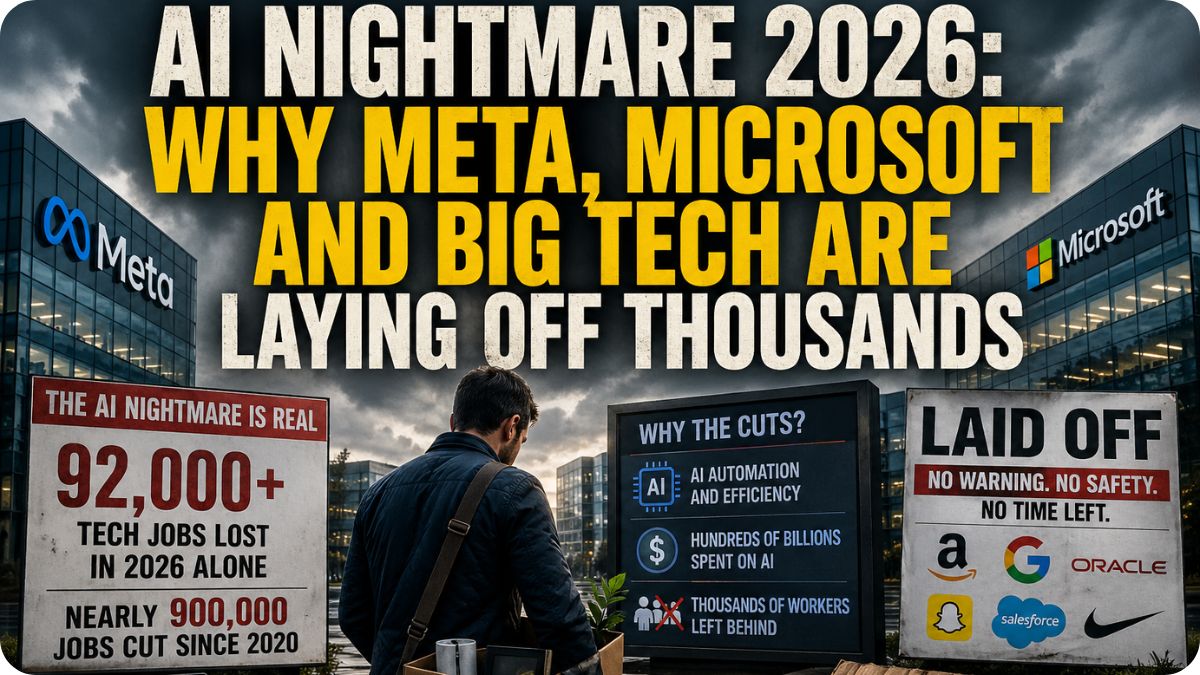
In a single week in early 2026, Meta and Microsoft together announced more than 20,000 potential job cuts. Meta told its employees through an internal memo that it was eliminating 10 per cent of its workforce, roughly 8,000 people, with cuts beginning on May 20. The company also quietly cancelled plans to fill 6,000 open roles it had been advertising.
Microsoft, a company that had never offered voluntary buyouts in its entire 51-year history, announced it was doing exactly that for the very first time. About 7 per cent of its US employees became eligible. With around 125,000 American staff on its books, that figure could translate to as many as 8,750 people walking out the door permanently. Those two announcements landed on the same day.
92,000 Jobs Gone in 2026 Alone, and the Year Is Not Over
To understand the true scale of the AI nightmare unfolding right now, you need to sit with the numbers for a moment. According to Layoffs.fyi, more than 92,000 tech workers have already lost their jobs in 2026. Since 2020, the total figure has climbed to nearly 900,000 people. That is not a typo.
Nine hundred thousand human beings, with mortgages and families and career ambitions, who have been forced to start all over again.
Amazon has cut at least 30,000 corporate and tech positions since October alone, representing about 10 per cent of its corporate workforce. Snap slashed 16 per cent of its staff, around 1,000 people. Salesforce eliminated 4,000 customer support roles in a single announcement. Oracle is in the middle of letting thousands go.
Nike, a company that sells shoes, laid off roughly 1,400 employees and most of those cuts fell directly on its technology department. Google has been conducting smaller but steady rounds of cuts since 2023, with no sign of stopping.
Every single one of these companies mentioned artificial intelligence in their announcements.
ALSO READ |OpenAI’s GPT-5.5 Can Think for Itself Now, and That Should Get Everyone’s Attention
The Cruel Irony at the Heart of the AI Nightmare
Here is the part that makes this story feel almost surreal. The very companies cutting tens of thousands of jobs are simultaneously spending hundreds of billions of dollars building the AI systems they say are making those cuts necessary.
Alphabet, Microsoft, Meta and Amazon are expected to spend a combined total of nearly $700 billion this year on AI infrastructure alone. That is $700 billion on the technology being used to justify eliminating the people who built these businesses in the first place.
Anthony Tuggle, an executive coach and leadership expert who previously worked inside the AI industry, described what is happening with unusual clarity. “This represents a fundamental structural shift rather than a temporary market correction,” he said. “We are witnessing the beginning of a permanent transformation in how work gets organised and executed across industries.”
That is not the language of a temporary rough patch. That is the language of something that does not reverse.
Is AI Really to Blame, or Is Something Else Going On?
This is where the AI nightmare story gets genuinely complicated, and where honest people disagree quite sharply.
There is a strong argument that AI is being used as a convenient cover for decisions that companies were going to make regardless. During the pandemic, tech giants hired at a frantic pace to meet a surge in demand that turned out to be temporary.
They overstaffed dramatically. Now, facing pressure from investors and slowing revenue growth, they need to slim down fast. Blaming AI sounds far better than admitting you hired too many people in 2021 and now need to quietly fix the mistake.
OpenAI CEO Sam Altman has actually called this out directly, using the phrase “AI washing” to describe companies that blame artificial intelligence for layoffs they were planning anyway. The pattern is not subtle at all.
When Block announced nearly 4,000 job cuts and cited AI efficiency as the primary reason, its stock price jumped the very next day. The financial incentive to frame a workforce reduction as a forward-thinking AI strategy, rather than a correction of past hiring mistakes, is enormous and impossible to ignore.
Meta offers a particularly striking example worth examining. The company recently announced it is shutting down its Metaverse platform Horizon Worlds by June. Reality Labs, the division that built that expensive and failed experiment, employed 15,000 people as recently as January 2026.
It is entirely reasonable to ask how much of the current Meta job cuts are genuinely about AI productivity gains and how much is simply cleaning up the wreckage of a very costly bet that did not work out.
ALSO READ |Google’s AI Writes 75% of Its Own Code, and Every Coder Should Pay Attention Right Now
The Hidden Truth Behind the AI Nightmare No One Wants to Say Out Loud
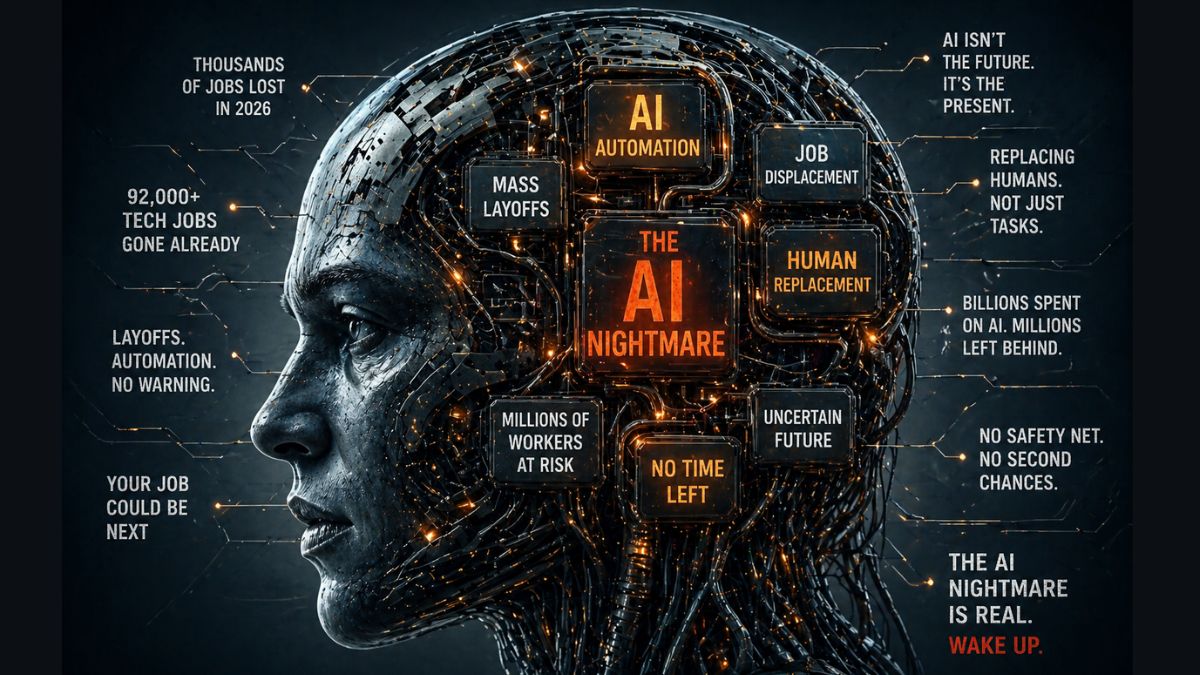
Beyond the two obvious narratives, there is a third explanation that most industry observers quietly find more persuasive than either extreme position.
Companies like Meta and Microsoft genuinely believe that AI is going to transform how software gets built and how knowledge work gets done. But they do not yet know exactly how, or at what pace, or which specific roles will change first.
Faced with that uncertainty, they are doing what large corporations typically do when they want to force rapid change through the organisation. They create pressure from above.
Cut headcount. Expect the same output from fewer people. Hand teams’ access to AI tools and watch what happens next. If the people who remain find ways to use AI to cover the gap left by those who were let go, the company has proven that the technology works and that it needed fewer people all along.
It is not a conspiracy. It is a business experiment conducted on the lives of real people who never agreed to be part of any experiment.
Google CEO Sundar Pichai has claimed that AI adoption has produced a 10 per cent increase in engineering speed across the company. That number maps uncomfortably neatly onto the 7 to 10 per cent workforce reductions most of these companies are announcing right now.
What the AI Nightmare Feels Like from the Inside
The human cost of all this does not live in the headlines or the earnings calls. It lives in the quiet anxiety of people who still have their jobs but are not sure for how long.
Glassdoor’s Employee Confidence Index found that the technology sector recorded the largest year-over-year drop in confidence of any industry in March, falling 6.8 percentage points to reach just 47.2 per cent. Fewer people are voluntarily leaving jobs than at any point in recent memory, not because they are satisfied with their work but because they are frightened. There is nowhere obviously safer to go right now.
Daniel Zhao, Glassdoor’s chief economist, explained the knock-on effect of this frozen labour market with precision. Because natural attrition has slowed so dramatically, companies are being forced to be more aggressive about reducing headcount through formal layoffs or by raising performance review standards to levels that effectively push people out.
The workers who leave quietly in normal times are simply not leaving. So, companies are finding other ways to move them along.
The workers most exposed in this environment are not necessarily those whose jobs can be fully replaced by AI today. They are the ones who are waiting for the disruption to arrive before deciding how to respond, rather than getting ahead of it now, while they still can choose.
The Startup World Has Already Moved on and Left Many Behind
While the AI nightmare wave dominates coverage at established companies, something different and arguably more consequential is happening in the startup world that rarely makes the front page.
Zach Bratun-Glennon, a partner at venture firm Gradient, described a shift that would have seemed impossible just five years ago. Companies are now reaching $50 million in annual revenue with as few as 50 employees.
That same milestone used to require a 250-person company for a typical software business not long ago. The tools available to small, AI-augmented teams today allow them to compress what once took years and hundreds of hires into months with a tiny group of well-equipped people.
Peter Morales, CEO of Code Metal, described the same reality even more directly. “Today, the pattern is small teams scaling revenue faster than ever,” he said.
This matters enormously for the broader jobs question. If the next generation of high-value companies is built with a fraction of the workforce, the jobs that AI creates may not come anywhere close to replacing the ones it eliminates, at least not within this decade.
History Gives Us Hope but No Guarantees Against the AI Nightmare
Every time a wave of technology threatened mass job displacement in history, the optimists were eventually proven right. New industries emerged. New job categories that had never previously existed became essential and well-paid.
Nobody in 1990 was training to be a mobile app developer or a cloud infrastructure engineer. Those jobs were invented by the disruption itself and they employed millions.
Techno-optimists are making exactly this argument today and they are not wrong to make it. Rajat Bhageria, CEO of AI startup Chef Robotics, acknowledged that AI will likely create new categories of work, while honestly admitting that what that looks like in the near term remains genuinely unclear.
That last admission carries enormous weight. The uncertainty itself is the cruellest part of the AI nightmare, because it makes planning impossible for the people most affected. Previous waves of automation mostly targeted physical or repetitive tasks.
This wave is directly targeting cognitive work, the kind that educated, well-paid professionals in comfortable careers always assumed would remain safely human. The speed and scale of the current disruption is genuinely different from anything that came before it, even if the long-term arc of history eventually bends back toward employment.
ALSO READ |Geoffrey Hinton’s 2026 AI Warning: Massive Job Cuts or a New Era of Hope?
The Only Question That Actually Matters Now
The question that will ultimately define this moment is devastatingly simple. What do these companies hire after the layoffs are done?
If Meta, Microsoft, Amazon and the rest rebuild with genuinely different skills, redesign their products around AI, and emerge faster and more capable than before, the case for this as a real productivity transformation will be difficult to argue with. The optimists will have been right.
If they simply pocket the payroll savings, post record profits for shareholders, and do not meaningfully change how they build or operate anything, then the AI nightmare will have served primarily as cover for a financial restructuring that benefited investors at the direct expense of workers.
Nobody knows yet which ending we are moving toward. But for the 92,000 people who have already lost their jobs this year, and the hundreds of thousands more sitting nervously at their desks wondering what comes next, the answer to that question cannot arrive soon enough.
Disclaimer:
This article is intended for general informational purposes only. All figures cited, including job loss statistics and financial projections, are sourced from publicly available reports, third-party tracking platforms, including Layoffs.fyi, company announcements and media coverage available as of April 2026. These numbers may change as new information becomes available. Readers are strongly encouraged to verify all information independently before making any decisions based on its contents.
Paban Kotoky, an MCA by qualification, serves as the Technical Head & Contributor at NestOfNews.com. He manages the overall technical operations of the platform and also contributes regularly, sharing his expertise on technology and emerging digital trends.