
|
Getting your Trinity Audio player ready...
|
For many people, managing money already means jumping between several apps. One platform for stocks, another for crypto, another for payments, and perhaps another for savings or investments. But that familiar routine could be changing faster than expected.
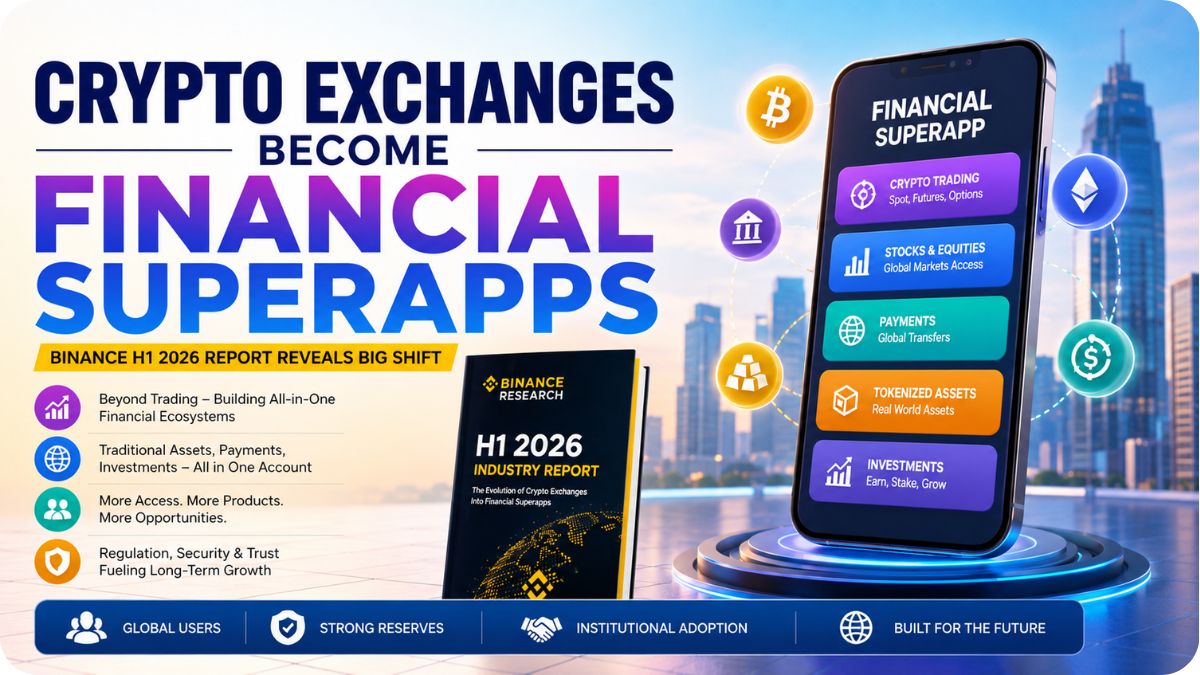
A new Binance Research report on the first half of 2026 highlights a major shift taking place across the cryptocurrency industry. Crypto exchanges are increasingly moving beyond their traditional role as places to buy and sell digital coins. They are becoming broader financial platforms that bring different types of financial services together under one roof.
The change is happening at an interesting time. Overall market activity has cooled from the extraordinary levels seen during previous crypto booms, while trading volumes have become more subdued. Yet the largest exchanges continue to attract a significant share of global liquidity.
This suggests that the crypto industry is entering a more mature phase. Instead of relying entirely on speculative trading, major platforms are looking for new ways to keep users engaged and expand their financial services.
Binance Report Highlights a Changing Crypto Landscape
The first half of 2026 showed a mixed picture for the digital asset industry.
On one side, spot market activity slowed compared with the strongest periods of the previous cycle. On the other, major exchanges continued to strengthen their position as users increasingly concentrated their activity on established platforms.
Binance remained one of the biggest beneficiaries of this trend, with the report highlighting its strong position across spot and derivatives markets. Its substantial holdings of major digital assets and stablecoins also underline the scale of its operations.
The bigger story, however, is not simply about market share. It is about what crypto exchanges are becoming. Instead of functioning only as digital asset marketplaces, leading platforms are gradually adding services that traditionally belonged to banks, brokers and payment companies.
ALSO READ |FIR Filed Against CoinDCX Founders: Full Truth Behind the Rs 71 Lakh Crypto Case
Traditional Finance Is Moving onto Crypto Platforms
One of the most important developments is the growing connection between crypto platforms and traditional financial products.
Users increasingly want access to more than Bitcoin and other cryptocurrencies. They want stocks, tokenised assets, investment products, and other financial opportunities without having to open accounts on multiple platforms. This demand is encouraging exchanges to expand their offerings.
Derivatives have remained an important part of the market, while new products linked to equities and other traditional assets are creating additional opportunities for users. Around the world, investors are also showing growing interest in tokenised financial products. The appeal is easy to understand.
A single platform can potentially give users access to crypto, traditional assets, payments and investment services without forcing them to move money between different financial applications constantly. That convenience could become one of the strongest competitive advantages in the next stage of digital finance.
The Rise of Always-On Investing
Another major change is the growing expectation that financial markets should always be available. Traditional stock markets operate within specific trading hours. Crypto markets, however, operate around the clock.
As exchanges introduce products connected to traditional assets, they are bringing some of that always-on experience into areas that were previously limited by conventional market schedules.
For investors in emerging markets, this can be particularly attractive. Access to international financial products has historically involved multiple restrictions, intermediaries and complicated procedures. Crypto platforms are attempting to simplify that experience.
The result could be a financial environment where the difference between a crypto account and a traditional investment account becomes increasingly difficult to see.
ALSO READ |Cryptocurrency Recognized as Property in India: Madras High Court’s Landmark Ruling
Stablecoins Face Slower Growth, But Their Use Is Expanding

Not every part of the crypto economy experienced rapid growth during the first half of 2026. Stablecoin supply growth slowed considerably, suggesting that the explosive expansion seen during earlier periods has lost some momentum. But the story does not end there.
Stablecoins are becoming increasingly useful beyond cryptocurrency trading. Their role in payments, transfers, settlement and other financial activities continues to attract attention from both businesses and institutions.
Crypto-linked payment cards are also gaining traction, while tokenised treasury products are attracting capital from investors looking for blockchain-based alternatives to traditional financial infrastructure.
This creates an interesting situation. Stablecoins may not be growing as quickly in supply, but their practical importance across the financial system appears to be increasing.
Banks Are Taking Blockchain More Seriously
Perhaps the biggest sign of change is coming from traditional financial institutions themselves.
Banks, brokerages and other established financial companies are increasingly exploring digital assets, tokenisation and blockchain infrastructure. This is important because the future of crypto may not depend entirely on retail traders buying and selling coins.
Instead, blockchain technology could gradually become part of the infrastructure supporting mainstream financial services. Tokenised assets, digital settlement systems and blockchain-based payment networks could eventually operate alongside traditional financial markets rather than completely replacing them.
For major financial institutions, the focus is increasingly shifting from short-term crypto speculation toward the underlying technology and its practical applications.
Regulation Could Shape the Next Chapter
Growth also brings greater scrutiny. Governments and regulators around the world are working to establish clearer rules for digital assets, exchanges, stablecoins and tokenised financial products. Regulatory developments in Europe, the United Kingdom and other major markets are pushing crypto companies toward greater transparency, compliance and accountability.
For the industry, this can be uncomfortable in the short term. Stronger regulations can increase operating costs and make some products more difficult to launch.
But clear rules could also provide something the crypto market has needed for years: greater confidence. If investors, banks and businesses know exactly what is permitted and what protections apply, wider adoption could become easier.
ALSO READ |India’s Crypto Boom: Tier-2 Cities & Women Investors Lead a New Digital Revolution
The Biggest Change May Be Happening Quietly
The most important development in crypto may not be the price of Bitcoin or the latest market rally. It could be the gradual disappearance of the boundary between cryptocurrency and traditional finance.
A person may eventually use the same financial account to hold digital assets, invest in stocks, make international payments, access tokenised securities and manage other investments. That is the idea behind the financial superapp.
These exchanges are positioning themselves to become the gateway to this new financial world. Whether they succeed will depend on regulation, security, consumer trust, product quality and their ability to compete with established banks and financial technology companies.
But one thing is becoming increasingly clear. The crypto exchange of the future may look very different from the exchange people knew a few years ago.
The industry is moving away from being simply a place to trade digital coins and toward becoming a broader financial ecosystem. And if this transformation continues, the way people manage money could become simpler, more connected and far more digital than ever before.
Disclaimer:
This article is intended for general informational and educational purposes only. It is based on publicly available information and discusses developments in the cryptocurrency and financial technology sectors. It should not be considered financial, investment, trading, legal or tax advice. Cryptocurrency and other financial products can involve substantial risks, including the possible loss of capital. Readers should independently verify information, consider their individual circumstances and consult a qualified financial professional before making investment or trading decisions. The publisher and author do not guarantee the accuracy, completeness or future performance of any company, asset, product or market discussed in this article.

Dr. Bidyut Barun Sarmah, with 22+ years of experience in print, electronic, and digital media, holds an MA and PhD in Mass Communication and Journalism. He has worked with AIR, Doordarshan, and the Publication Division under the Ministry of Information and Broadcasting. A published author and researcher, Dr. Sarmah writes extensively in both Assamese and English. He was also awarded a prestigious fellowship by the Ministry of Culture, Government of India, for his study on journalistic literature—an achievement that highlights his depth of scholarship and contribution to media studies. At Nest of News, he leads the editorial team and contributes across diverse topics.