
|
Getting your Trinity Audio player ready...
|
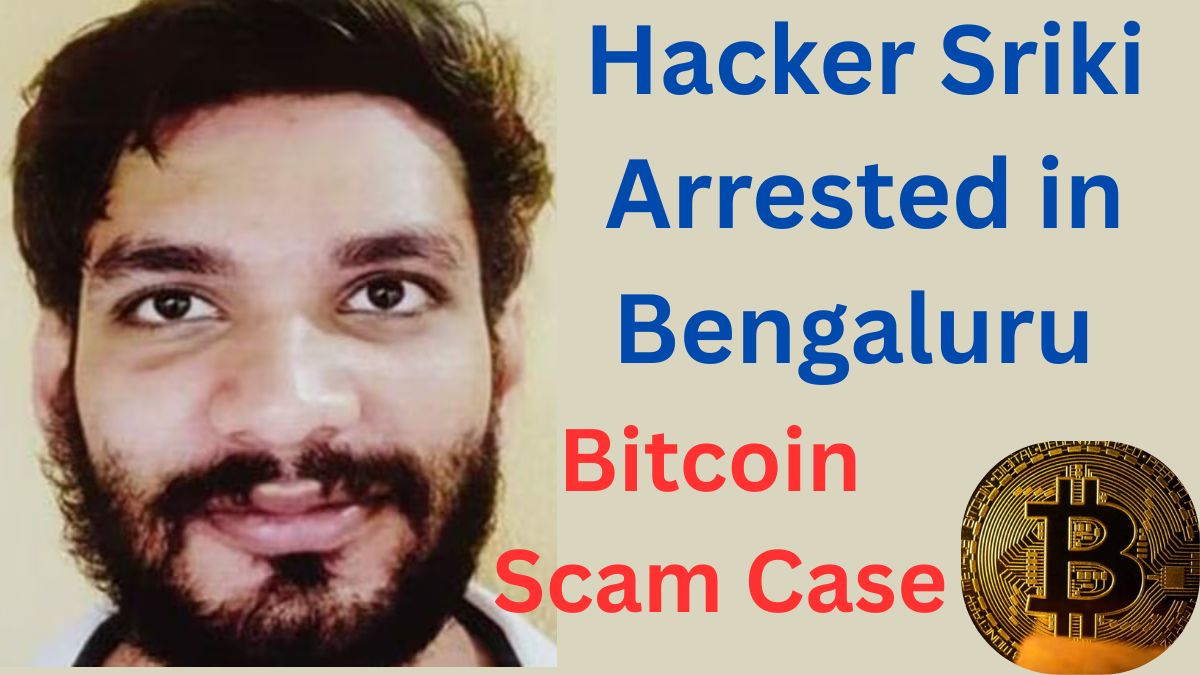
The arrest of hacker Sriki in the Bengaluru Bitcoin scam has once again pulled Karnataka into the spotlight of one of India’s most controversial cybercrime investigations. On May 9, 2026, the Enforcement Directorate finally took Srikrishna Ramesh, widely known as Sriki, into custody after years of allegations involving stolen Bitcoins, darknet transactions, international hacking operations and suspected political links.
But this is not just another cryptocurrency fraud story. The Bengaluru Bitcoin scam has become a symbol of how cybercrime, money laundering and political influence allegedly intersected behind the scenes while investigators struggled for years to bring the accused to justice.
Hacker Sriki Arrested: What Really Happened on May 9
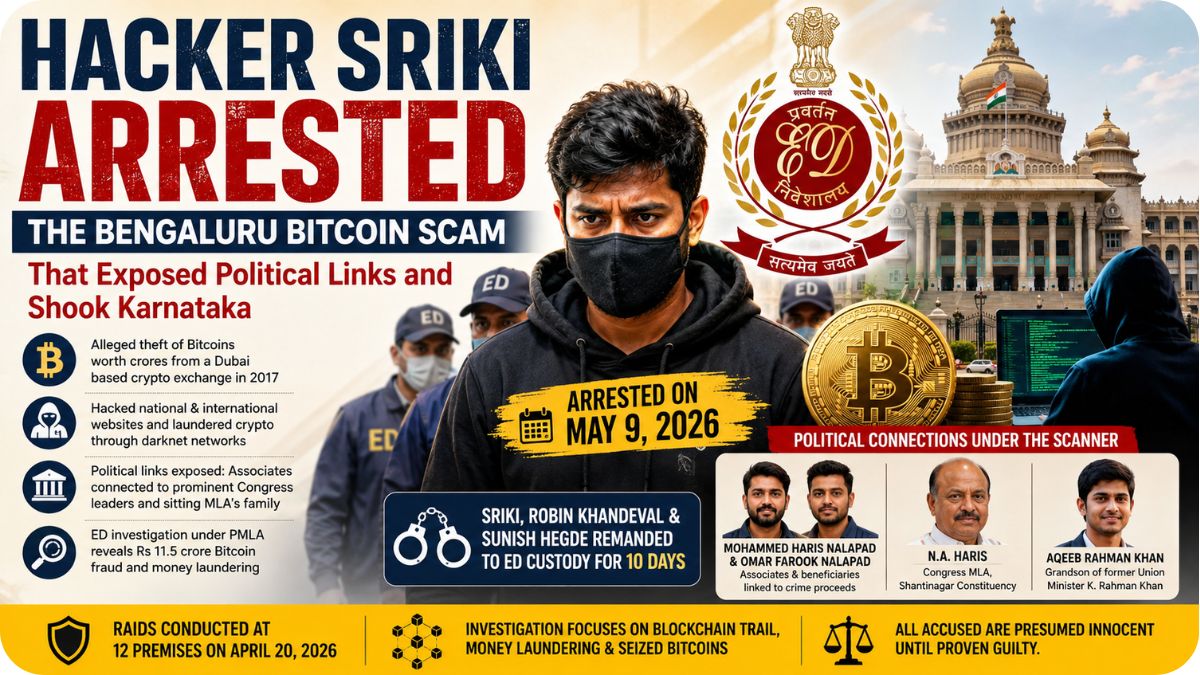
The ED moved swiftly and quietly. Sriki was arrested along with two others, Robin Khandeval and Sunish Hegde, in coordinated action across Bengaluru.
All three were produced before a special ED court on the same day. The court remanded them into ED custody for 10 days, giving investigators the time they needed to dig deeper into one of Karnataka’s most explosive financial fraud cases in recent memory.
This was not an impulsive action. It came after weeks of intensified raids, months of financial tracking and years of painstaking investigation into the alleged Rs 11.5 crore Bitcoin scam.
ALSO READ |Cryptocurrency Trading Fraud Shatters Trust as Businessman Loses Rs 1.56 Crore
The Case That Started with Drugs and Grew into Something Much Larger
Most people do not realise that this entire case began not with Bitcoin theft but with a drug purchase on the dark web.
Back in November 2020, Karnataka Police arrested Sriki in what appeared to be a routine cybercrime and drug case. He had allegedly been buying hydro ganja on the darknet using Bitcoin. It seemed straightforward enough.
But when investigators looked closer, they found something far more disturbing. Beneath the drug case was a hidden world of hacking operations, stolen cryptocurrency, compromised gaming platforms and illegal transactions on darknet marketplaces.
What started as one arrest quickly became a multi-agency probe involving the Central Crime Branch, the CID, the CBI and eventually the Enforcement Directorate.
Understanding the Sriki Bitcoin Scam: The Full Story Explained
To understand why this case matters so much, it helps to go back to 2017.
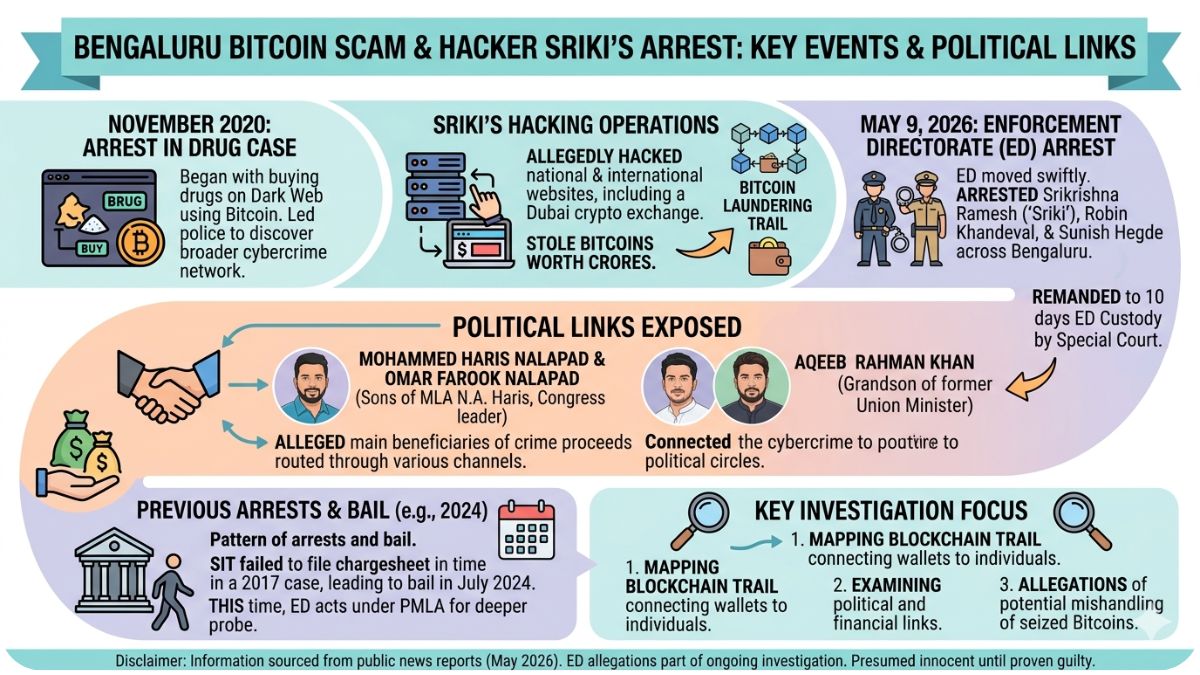
That year, Sriki and his associates allegedly carried out a series of hacking attacks targeting national and international websites. One of the most significant alleged thefts involved a Dubai based cryptocurrency exchange, from which Bitcoins worth crores were reportedly stolen.
The stolen digital currency did not simply disappear. According to the ED, it was carefully laundered through a chain of transactions designed to obscure its origins. Investigators believe portions of that stolen cryptocurrency were eventually routed to individuals with deep political connections in Karnataka.
Hacker Sriki Arrested Alongside Associates with Political Connections
This is the part of the story that turned a cybercrime case into a political firestorm.
The ED’s investigation under the Prevention of Money Laundering Act, 2002, pointed to two names that sent shockwaves through Karnataka’s political circles. Mohammed Haris Nalapad and his brother Omar Farook Nalapad were allegedly close associates of Sriki and, according to the agency, among the main beneficiaries of the crime proceeds.
Their father, N.A. Haris is the sitting MLA of Shantinagar constituency in central Bengaluru and a prominent Congress leader. The moment his sons’ names surfaced in a Bitcoin fraud case, the political temperature in the state rose sharply.
The ED also named Aqeeb Rahman Khan, grandson of former Union Minister K. Rahman Khan and nephew of Congress leader Mansoor Ali Khan. Investigators alleged suspicious money transfers through his bank accounts and claimed he was another direct beneficiary of the stolen funds.
These are not ordinary names. And that is precisely why this case refused to stay quiet.
The April 2026 Raids That Made the Arrest Possible
Before the arrests came the raids. On April 20, 2026, the ED conducted coordinated searches across 12 premises in Bengaluru and connected locations.
The raids covered properties linked to Sriki, the Nalapad brothers and Aqeeb Rahman Khan. Investigators combed through financial documents, digital devices and transaction records, building the evidentiary foundation needed to justify custodial arrests.
Those raids clearly yielded results. Less than three weeks later, Sriki and two others were in ED custody.
A Painful Pattern: How Sriki Kept Walking Free
One of the most frustrating aspects of this case, for investigators and the public alike, is how many times Sriki was arrested and then released.
After his 2020 arrest, the case expanded, but legal processes moved slowly. Then on May 7, 2024, the Special Investigation Team arrested him again in connection with the alleged theft of 60.6 Bitcoins from cryptocurrency exchange Unocoin, a crime dating back to 2017.
What happened next was deeply disappointing. The SIT failed to file a chargesheet within the mandatory 60-day window required by law. On July 23, 2024, a Tumakuru court had no choice but to grant him conditional bail. He walked free. Again.
That is why this latest ED arrest carries so much weight. The Enforcement Directorate operates under PMLA, which gives it separate legal authority and different procedural timelines. This time, authorities appear determined not to let the case slip away again.
The Disturbing Question About Seized Bitcoins
There is one thread in this investigation that is particularly unsettling.
The ED is not only looking at how the Bitcoins were stolen and laundered. It is also examining allegations that portions of the seized cryptocurrency may have been diverted or mishandled during the early stages of the investigation itself.
In simpler terms, some of the Bitcoins that were supposed to be in state custody may not have been handled correctly. That allegation, if proven, would represent a serious failure within the very system meant to protect public assets. This dimension of the case has added a layer of gravity that goes far beyond Sriki himself.
What Comes Next in the Bengaluru Bitcoin Scam Case
With Sriki and his associates in ED custody for 10 days, investigators will push hard on several fronts.
They will work to map the full blockchain trail of the stolen Bitcoins, connecting wallet addresses to real identities. They will press for information on who received what, when and how. And they will continue examining the political and financial links that have made this case so sensitive for so long.
Fresh arrests cannot be ruled out. Neither can further raid or new names entering the frame as the investigation deepens.
ALSO READ |FIR Filed Against CoinDCX Founders: Full Truth Behind the Rs 71 Lakh Crypto Case
Why Every Indian Should Care About This Case
This is not a story limited to Bengaluru or Karnataka. It is a warning sign for the entire country about how poorly understood cryptocurrency was in the years before proper regulation arrived.
It shows how digital assets, when mishandled or stolen, can disappear into networks of politically connected individuals. It reveals the dark web not as an abstract concept but as a real marketplace that fed into a very real financial crime.
And it raises uncomfortable questions about accountability, not just for the accused but for the institutions that were supposed to act faster.
Sriki is in custody today. But the full truth of what happened to those Bitcoins, where they went, who benefited and who looked the other way, is still waiting to be told completely. Karnataka is listening. So is the rest of India.
Disclaimer:
This article is based on information sourced from publicly available information. The Enforcement Directorate’s allegations are part of an ongoing investigation and have not been proven in a court of law. All individuals named in this article are presumed innocent until proven guilty. This publication does not intend to defame any individual or organisation. Readers are advised to follow official court proceedings and authoritative news sources for further updates on this case.
Dr. Bidyut Barun Sarmah, with 22+ years of experience in print, electronic, and digital media, holds an MA and PhD in Mass Communication and Journalism. He has worked with AIR, Doordarshan, and the Publication Division under the Ministry of Information and Broadcasting. A published author and researcher, Dr. Sarmah writes extensively in both Assamese and English. He was also awarded a prestigious fellowship by the Ministry of Culture, Government of India, for his study on journalistic literature—an achievement that highlights his depth of scholarship and contribution to media studies. At Nest of News, he leads the editorial team and contributes across diverse topics.