
|
Getting your Trinity Audio player ready...
|
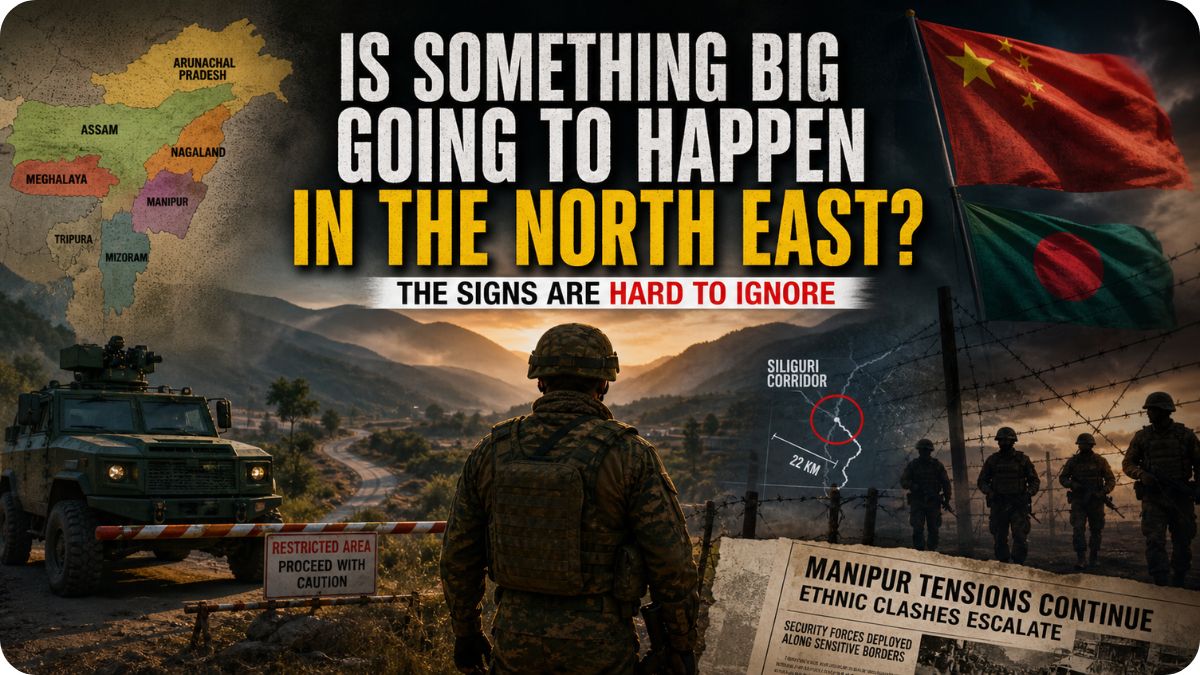
Is something big going to happen in the North East? That is the question several defence analysts and geopolitical observers are now finding impossible to set aside. Nobody wants to be the person who says something terrible is coming.
But when you watch enough signals accumulate in the same direction over a long enough period of time, staying quiet starts to feel more irresponsible than speaking up. The honest answer, based on what is being seen and reported on the ground, is that nobody can say for certain. But the signs are gathering in a way that is genuinely difficult to dismiss, and the questions being raised deserve serious and open discussion.
Is Something Big Going to Happen in the North East? The Troop Movements Are Raising Eyebrows

Here is what has been observed and what has people quietly worried. Armoured Mahindra Marksman vehicles, the kind specifically engineered to withstand mines and IED explosions and typically associated with conflict zones like Kashmir, have reportedly been spotted in sensitive areas of India’s eastern regions.
These are not vehicles associated with routine peacekeeping or standard security arrangements. Their presence, if confirmed and sustained, would suggest preparation for something considerably more serious than ordinary law enforcement.
The Army, the BSF and the Assam Rifles all appear to be conducting operations with an intensity and coordination that goes beyond what would normally be expected. Intelligence-driven sweeps are reportedly underway along key border stretches. None of this proves that something dramatic is imminent. But it raises a question that thoughtful observers are finding hard to set aside.
Manipur Has Been Hurting for a Long Time, and the Wounds Are Still Open
Any honest conversation about the North East has to begin with Manipur, because Manipur is where so much of the current tension is concentrated and where the roots of the problem run deepest. This is not a crisis that appeared suddenly.
What began roughly two to three years ago as a conflict with origins in drug networks and ethnic rivalry between the Meitei and Kuki communities has slowly evolved into something harder to define and harder to resolve.
The apprehension being expressed now is that a conflict that has so far remained between two communities could potentially draw in other tribal groups across the region.
That kind of widening, if it were to happen, would transform an already painful situation into something far more complex and far more difficult to contain. The possibility, not the certainty, but the genuine possibility of that escalation may be part of what is driving the current urgency in security posture.
Could the Chicken Neck Become a Target? The Question Itself Is Alarming
The Siliguri Corridor, that narrow strip of land barely 22 kilometres wide at its tightest point that connects mainland India to all eight North Eastern states, is a geographical vulnerability that strategic planners never stop thinking about. Known as the Chicken Neck, this corridor is the single land thread by which an enormous and vital part of India remains connected to the rest of the country.
The worry is not necessarily that the Chicken Neck faces an immediate physical threat. The worry is that sustained instability in the North East, of the kind that multiple pressures could produce simultaneously, might create conditions that invite unwanted attention toward that corridor from actors who have long understood its significance.
China understands it. Observers of Bangladesh’s shifting political landscape are thinking about it. And anyone studying India’s strategic vulnerabilities has this corridor near the top of their list of concerns.
Is China Involved? Nobody Is Saying Yes for certain, but Nobody Is Fully Relaxed Either
This is where the analysis moves from the observable to the apprehensive, and it is important to be clear about that distinction. Nobody is presenting confirmed evidence of direct Chinese military involvement in the current North East situation. What analysts are pointing to instead is a pattern of circumstances that, taken together, raise legitimate questions.
China has spent years building formidable infrastructure along its side of the border with India’s northeastern states. Roads, forward positions, surveillance networks and logistical capacity that significantly exceed what India has managed to construct in response.
The territorial dispute over Arunachal Pradesh remains alive and periodically provocative. And China’s historical record of supporting or tolerating insurgent networks that operate against Indian state authority in peripheral regions is a matter of documented concern rather than mere speculation.
The fear is not necessarily a Chinese army crossing a border. The more unsettling fear is that instability in the North East, however it originates, could serve external interests in ways that make resolution harder and harder to achieve.
ALSO READ |China Conducted Nuclear Test After Galwan Clash, US Makes Explosive Claim
What Is Happening Along the Bangladesh Border and Should We Be Concerned?
India’s relationship with Bangladesh has changed in ways that would have seemed unlikely just a few years ago. The long and complicated border that the two countries share runs directly alongside several of India’s most sensitive North Eastern states, and the nature of cross-border movement, both of people and of other things, has always been a matter of ongoing security concern.
With Bangladesh’s internal political situation having shifted considerably and the bilateral relationship between the two countries carrying new uncertainties, there is a reasonable question about whether India’s eastern flank is more exposed than it was before.
This is not a statement of confirmed threat. It is an acknowledgement that a border which was once managed within a more predictable diplomatic relationship now requires a different kind of attention.
Could Secessionist Sentiment Find New Life in the Current Climate?
This is perhaps the most sensitive question of all, and it deserves to be asked carefully and responsibly. The North East has a long history of secessionist movements across multiple states, some of which have entered peace processes over the years, while others have maintained varying degrees of activity.
The concern being expressed in analytical circles is whether the current intensity of ethnic conflict in Manipur, combined with other regional pressures, might create an environment in which secessionist aspirations that had been gradually receding find new energy.
The reported apprehension of individuals of foreign origin within the region, and the suggestion that intelligence has since identified further connections linked to those cases, adds a layer of external dimension to what might otherwise seem like a purely internal situation.
When foreign networks appear to have a footprint in a region with this kind of history, the question of what they are there for and what they might be supporting becomes deeply important.
What Sree Iyer and Analysts Like Him Are Actually Saying
Geopolitical analyst Sree Iyer of PGurus has been raising these concerns on his platform with consistency and with careful qualification. His position is not that the catastrophe is certain.
His position is that the convergence of signals, the troop movements, the nature of the equipment being deployed, the intelligence-driven operations, the history of the Manipur conflict and the broader regional pressures is creating a picture that responsible observers cannot simply ignore.
The analytical framework being applied is one of pattern recognition rather than panic. Individual data points can each have innocent explanations. But when multiple unusual patterns emerge simultaneously in the same region, the responsible question to ask is whether they are connected and what they might collectively signal. That question is what is being asked, and it deserves a serious public conversation rather than dismissal.
The People of the North East Are the Ones Who Will Feel Whatever Comes Next
Behind all the strategic language and analytical framing are real people. Families in Imphal and Churachandpur have already lived through years of ethnic tension and violence.
Communities in villages across Nagaland, Assam and Meghalaya who go about their daily lives in a region that the rest of India often forgets exists until something dramatic forces it into the headlines. Children growing up in a part of their own country where the idea of normal and peaceful life has become something their parents remember rather than something they experience.
Whatever may or may not be coming, whatever the security situation ultimately produces, the human dimension of this story must not be lost in the strategic analysis. The North East and its people carry a weight of historical neglect and repeated conflict that no community should have to bear indefinitely. They deserve better answers and better outcomes than the ones this region has received so far.
Is Something Big Going to Happen in the North East? We Genuinely Do Not Know, but We Cannot Stop Asking
This is where honesty requires a clear statement. No analyst, no matter how well informed, can say with certainty what is going to unfold in the North East in the coming weeks and months. What can be said is that the signals being observed are serious enough to warrant genuine public attention and open discussion.
The apprehension is real. The questions are legitimate. And the possibility that something significant is being prepared, either by Indian security forces responding to specific intelligence, or by the forces of instability that have long troubled this region, cannot be responsibly ruled out.
Is something big going to happen in the North East? Perhaps the most important thing right now is simply that more people are asking the question. Because regions that get ignored tend to produce surprises. And this particular region has been ignored for far too long.
Disclaimer:
This article is published for informational and analytical purposes and is based on publicly available information and commentary, including views expressed by Sree Iyer. The analysis presented reflects opinion and interpretation and should not be considered verified news, confirmed intelligence, or official statements. No claims are made regarding the accuracy or imminence of any events discussed. This content does not report on confirmed military operations or government actions. Readers are encouraged to consult official government sources and established news organizations for verified and up-to-date information. This publication operates independently and is not affiliated with any government body, political party, military institution, or intelligence agency.

Dr. Bidyut Barun Sarmah, with 22+ years of experience in print, electronic, and digital media, holds an MA and PhD in Mass Communication and Journalism. He has worked with AIR, Doordarshan, and the Publication Division under the Ministry of Information and Broadcasting. A published author and researcher, Dr. Sarmah writes extensively in both Assamese and English. He was also awarded a prestigious fellowship by the Ministry of Culture, Government of India, for his study on journalistic literature—an achievement that highlights his depth of scholarship and contribution to media studies. At Nest of News, he leads the editorial team and contributes across diverse topics.