
|
Getting your Trinity Audio player ready...
|
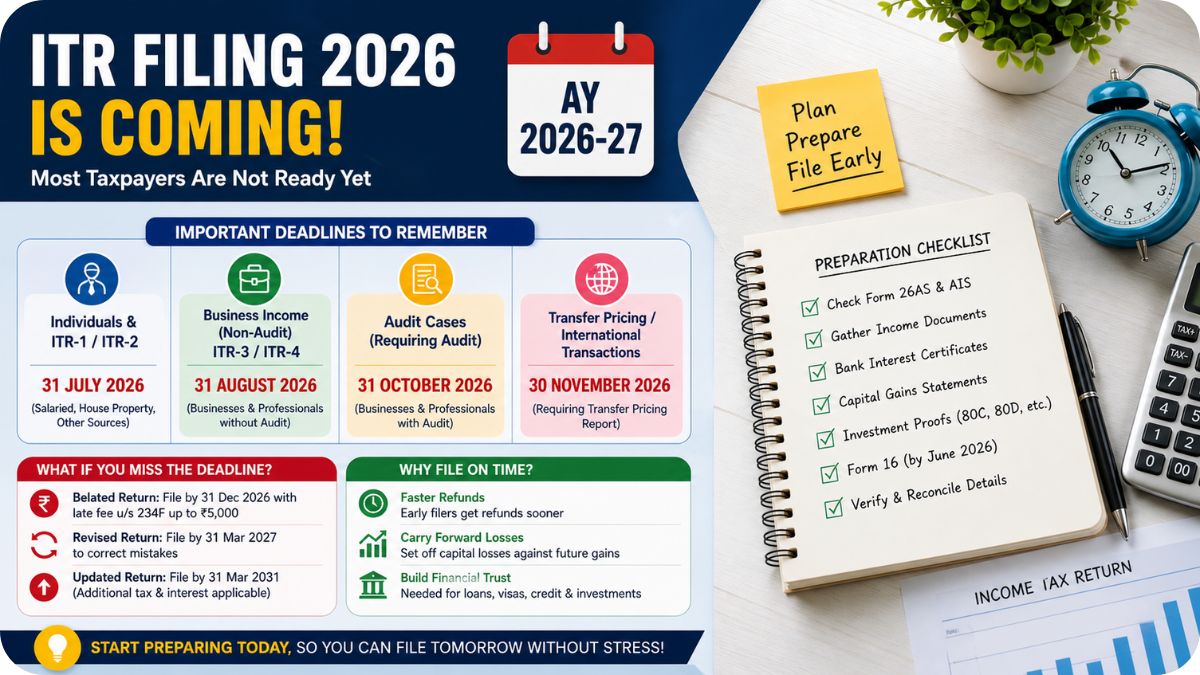
Every year, the same story repeats itself. The financial year ends quietly, and suddenly millions of people realise they have no idea when to file their income tax return(ITR filing), what documents to gather or what happens if they miss the deadline. If that sounds familiar, you are not alone, and this article is written just for you.
The good news is that there is still time. The filing window for Assessment Year 2026-27 has not even opened yet. But that does not mean you should sit back and relax. The deadlines are real, the penalties are real, and the preparation needs to start right now.
Why ITR Filing Has Not Started Yet and When It Will
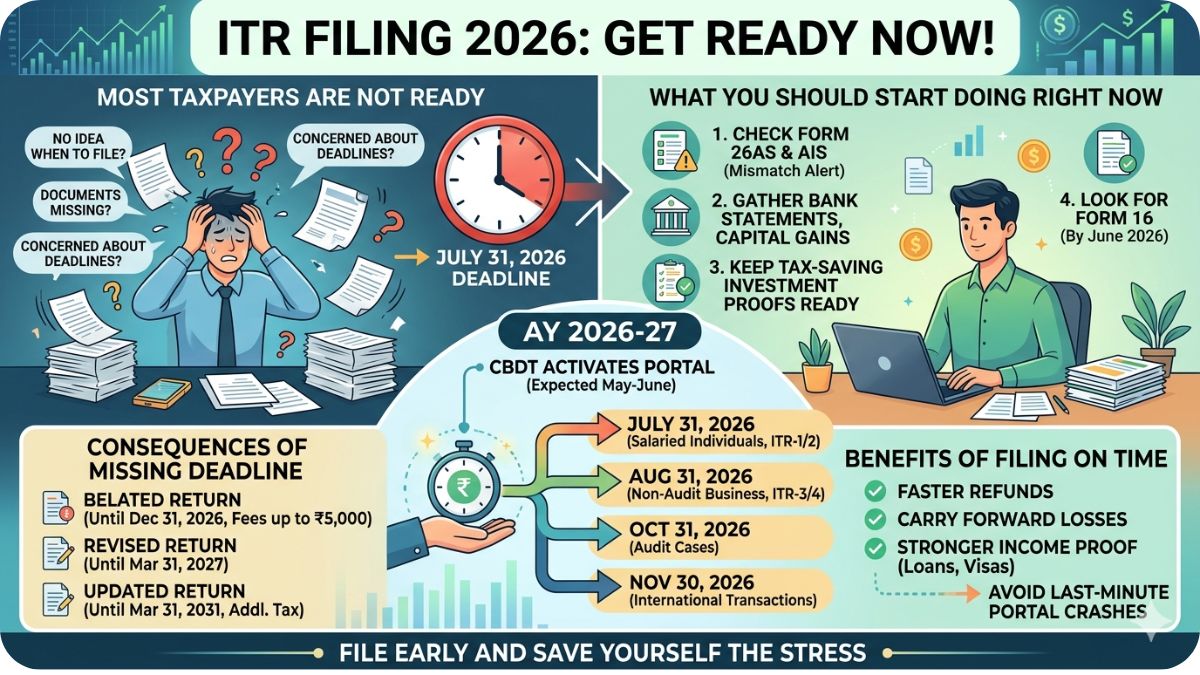
Here is something that surprises many taxpayers every year. The income tax filing season does not begin automatically on April 1. It begins only when the Central Board of Direct Taxes, commonly known as CBDT, activates the return form utilities on the official e-filing portal.
These utilities come in two forms: either as an online filing option directly on the portal or as a downloadable Excel-based tool. Until these are switched on, no one can upload their return for AY 2026-27, no matter how prepared they are.
In most years, this activation happens around May. Last year was an exception because major changes were made to several ITR forms following revised capital gains rules, which pushed the opening to June. Experts are hopeful that this year the process will move faster, and filing is expected to begin very soon.
So, if you have been checking the portal and finding nothing, that is completely normal. Your wait is almost over.
ALSO READ |Income Tax Refund Delay 2025: Why Refunds Are Late and When You Can Expect Them
ITR Filing Last Date 2026: The Deadlines You Cannot Afford to Forget
Once the filing window opens, different categories of taxpayers have different deadlines. Knowing yours is not optional; it is essential.
If you are a salaried individual or someone filing through ITR-1 or ITR-2, your deadline is July 31, 2026. This is the most important date for the largest group of taxpayers in India, and missing it comes with real consequences.
Taxpayers with business income who fall under non-audit cases and file through ITR-3 or ITR-4 have until August 31, 2026.
Those whose accounts require a formal audit must file by October 31, 2026. Businesses involved in international transactions or specified domestic transactions that require a transfer pricing report have until November 30, 2026.
What Happens If You Miss the Deadline
Missing the due date does not mean your world falls apart, but it does make things harder and more expensive. A belated return can be filed until December 31, 2026. However, you will be charged a late filing fee under Section 234F, which can go up to Rs 5,000 depending on your income level.
If you filed on time but later discovered a mistake, you can file a revised return until March 31, 2027.
For those who missed everything and want to correct past returns, an updated return can be submitted as late as March 31, 2031. That gives you four full years from the end of the assessment year, though additional tax and interest will apply.
Why Filing on Time Is About More Than Just Avoiding a Fine
Most people think of the deadline as a threat. In reality, it is an opportunity. When you file on time, your refund gets processed faster. The income tax department prioritises early filers, and that can mean money back in your account weeks or even months sooner.
Filing on time also protects something very valuable, your ability to carry forward capital losses. If you have made losses in stocks or mutual funds during the year, filing before the deadline lets you carry those losses forward and set them off against future gains. Miss the deadline, and that benefit is gone permanently for that year.
Beyond taxes, your filed ITR works as an income proof for home loan applications, visa processing, credit card approvals and investment documentation. Banks and embassies increasingly ask for two to three years of filed returns. The earlier you build that record, the stronger your financial profile becomes.
ALSO READ |PPF Can Pay You Rs 61,000 Every Month After You Retire and Most Indians Have No Idea
What You Should Start Doing Right Now
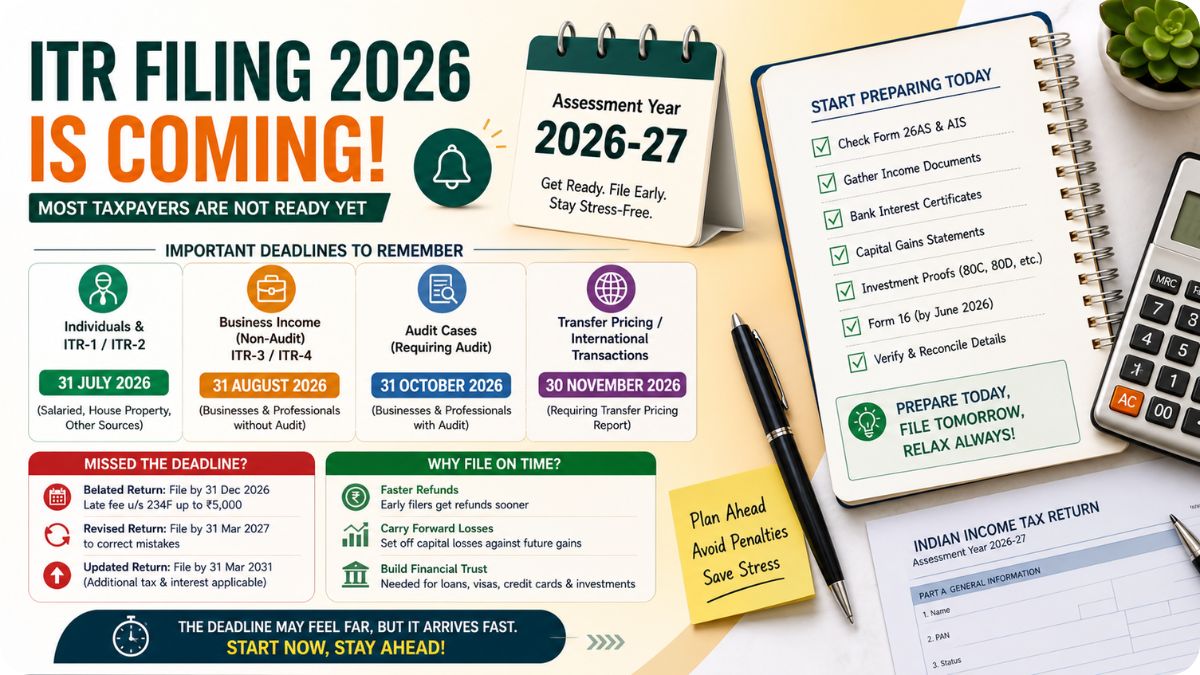
The filing window may not be open yet, but that does not mean you have nothing to do. The smartest taxpayers use this gap to get completely organised.
Start by logging into the income tax portal at incometax.gov.in and checking your Form 26AS and Annual Information Statement, known as AIS. These documents reflect all the income and tax details the government has on record for you. Any mismatch between these figures and your own records needs to be identified and addressed before you file.
Gather your bank interest certificates, capital gains statements from your broker or mutual fund platform, and proof of all tax-saving investments made during FY 2025-26. If you invested in PPF, ELSS, NPS, paid your insurance premium or made a home loan repayment, keep those documents ready.
If you are a salaried employee, your employer will issue Form 16 by June 2026. This document is the backbone of your ITR. Once you have it, the actual filing process becomes much simpler.
ALSO READ |LIC Jeevan Utsav Plan: One-Time Premium, Lifetime Security ; Smart Move or Costly Choice?
File Early and Save Yourself the Stress
Every year, the days leading up to July 31 see the income tax portal slow down, crash briefly or become difficult to navigate simply because millions of people are trying to file at the same time. Early filers never face this problem.
Filing in May or June gives you breathing room. If something goes wrong, such as a mismatch in your AIS, an error in your Form 26AS or a missing document, you have enough time to fix it without panic.
There is also a quiet confidence that comes from having your taxes done early. It is one less thing to worry about during a busy monsoon season.
The deadline of July 31, 2026, may feel like it is far away right now. But anyone who has lived through a few tax seasons knows how quickly that date arrives. The best time to start preparing is today, while the pressure is low and the options are wide open.
Disclaimer:
This article is intended for general informational purposes only and does not constitute professional financial, legal or tax advice. Tax laws and deadlines are subject to change. Readers are advised to consult a qualified chartered accountant or tax advisor before making any financial decisions. All information is based on publicly available data and is accurate to the best of our knowledge at the time of publication.

Dr. Bidyut Barun Sarmah, with 22+ years of experience in print, electronic, and digital media, holds an MA and PhD in Mass Communication and Journalism. He has worked with AIR, Doordarshan, and the Publication Division under the Ministry of Information and Broadcasting. A published author and researcher, Dr. Sarmah writes extensively in both Assamese and English. He was also awarded a prestigious fellowship by the Ministry of Culture, Government of India, for his study on journalistic literature—an achievement that highlights his depth of scholarship and contribution to media studies. At Nest of News, he leads the editorial team and contributes across diverse topics.