
|
Getting your Trinity Audio player ready...
|
For every salaried employee, a salary slip is more than just numbers. It reflects hard work, security, and future dreams. That is why any talk of change naturally creates both curiosity and concern. The growing discussion around the New Labour Code 2026 has sparked exactly that mix of emotions across India.
While many headlines suggest immediate changes, it is important to keep one key fact in mind. The new labour code has not yet been fully implemented. However, if it does come into force, it could reshape how salaries are structured and how employees build their financial future.
What is the New Labour Code 2026, and why does it matter
The New Labour Code 2026 is part of a major reform where multiple labour laws are merged into simplified rules. The goal is to make salary structures more transparent, fair, and consistent across industries.
At the heart of this reform lies a simple but powerful idea, the 50 per cent wage rule. This rule changes how your salary components are divided, bringing long-term benefits into focus.
Understanding the 50 per cent wage rule in simple terms
Under the proposed structure, at least half of your total salary must be counted as basic pay and dearness allowance. This means companies can no longer keep basic salary artificially low while increasing allowances.
If allowances go beyond 50 per cent, the extra amount will automatically be treated as part of the basic salary. This creates a more balanced and standard salary structure.
A real example that shows the impact
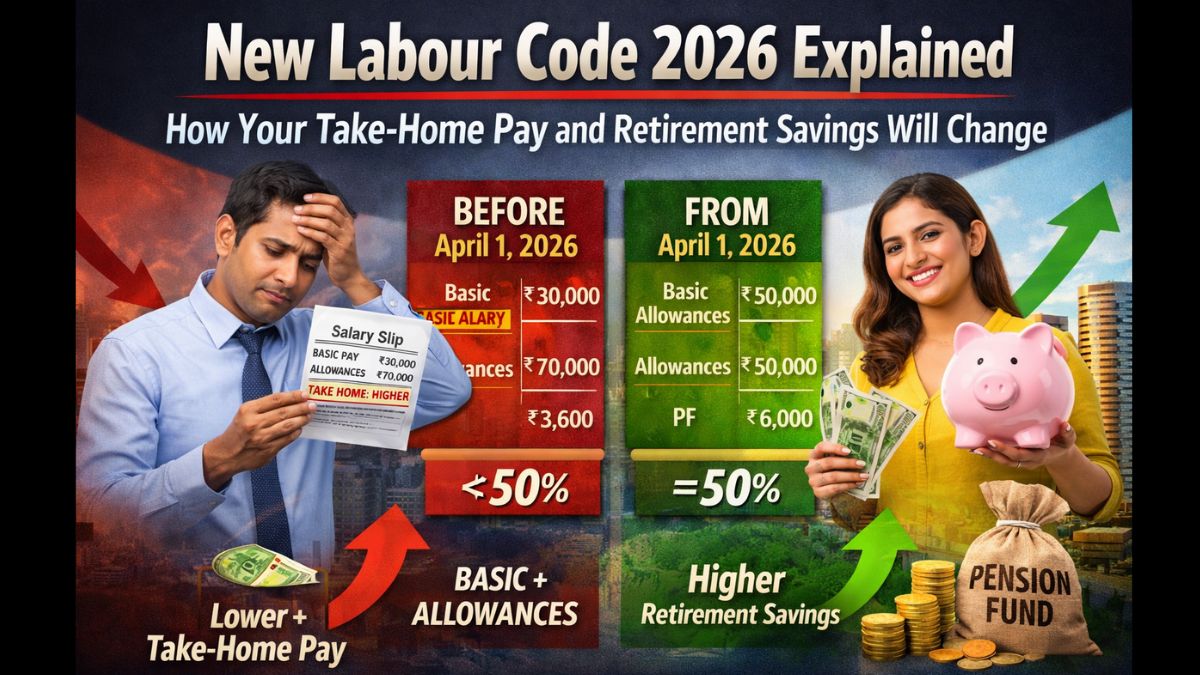
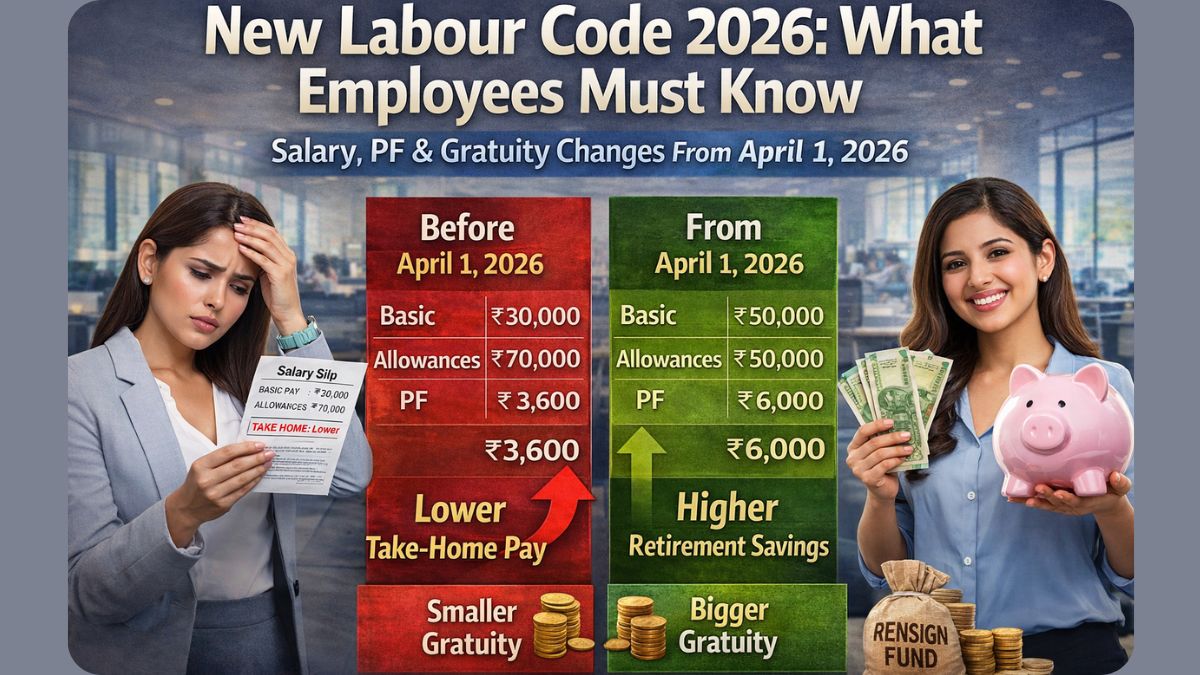
Let us take a simple example of a monthly salary of ₹1,00,000. Before the new labour code, a typical structure could look like this. Basic salary ₹30,000 and allowances ₹70,000. The PF contribution would be ₹3,600, leaving a higher take-home salary.
If the new rule is implemented, the same salary may be restructured. Basic salary becomes ₹50,000, and allowances are ₹50,000. PF contribution rises to ₹6,000, which slightly reduces the monthly take-home. At first glance, this feels like a loss. But the reality goes deeper than that.
Why does the take-home salary feel lower?
If implemented, employees may notice a small drop in their in-hand salary. This happens because a larger portion of income is directed toward the provident fund and other long-term benefits. It may feel uncomfortable in the beginning, especially for those who rely on a higher monthly cash flow.
ALSO READ |10 Big Changes from 1 April 2026: Relief in Some Areas, But Rising Costs May Hit Your Pocket
The hidden benefit that builds your future

This change is not about reducing your earnings. It is about strengthening your financial foundation. With a higher basic salary, both employee and employer contributions to the provident fund increase. Over time, this builds a much larger retirement corpus.
In addition, gratuity benefits also grow because they are calculated based on basic salary. This means better rewards for long-term employment.
Important reality employees must not ignore
Despite all the discussion, the most important point remains that the New Labour Code 2026 is not fully implemented yet. There is no confirmed nationwide rollout date at this moment.
Companies will need time to update their systems, policies, and payroll processes. Until then, employees should not expect immediate changes in their salary structure.
ALSO READ|Five Big Changes in Form 16: A Positive Shift for Salaried Employees Under New Form 130
Final thoughts
The New Labour Code 2026 brings a sense of hope for a more secure and structured financial future. While the idea of a lower take-home salary may create initial discomfort, the long-term advantages are hard to ignore.
It is not a reduction in income, but a shift in how money is saved and secured for tomorrow. If implemented thoughtfully, this reform could quietly transform how millions of employees build wealth over time.
Disclaimer:
This article is for informational and news purposes only. It does not provide financial or legal advice. Readers are advised to consult professionals before making any employment or financial decisions.

Dr. Bidyut Barun Sarmah, with 22+ years of experience in print, electronic, and digital media, holds an MA and PhD in Mass Communication and Journalism. He has worked with AIR, Doordarshan, and the Publication Division under the Ministry of Information and Broadcasting. A published author and researcher, Dr. Sarmah writes extensively in both Assamese and English. He was also awarded a prestigious fellowship by the Ministry of Culture, Government of India, for his study on journalistic literature—an achievement that highlights his depth of scholarship and contribution to media studies. At Nest of News, he leads the editorial team and contributes across diverse topics.