
|
Getting your Trinity Audio player ready...
|
SEBI will rationalise regulations, and for millions of exhausted investors and traders across India, those four words from Chairman Tuhin Kanta Pandey on Saturday felt like the first breath of fresh air in a very long time. It has been a punishing year.
Every few months, a new rule arrived. A new cost. A new compliance step that quietly ate into time, capital and strategy. The Securities Transaction Tax went up sharply. Margin rules got tighter. The mutual fund framework was rewritten entirely.
Algorithmic trading now requires formal approvals and registered IP addresses. And brokers raised their fees on top of everything else, without fanfare and without apology.
So when SEBI sat down to mark its 38th foundation day, investors and traders across the country were not watching for ceremony. They were watching for signals. And what Pandey delivered was, unexpectedly, something close to reassurance.
“The coming years will demand not just regulation, but vision. Not just oversight, but insight,” he said. For a regulator that has spent much of the past year adding rules rather than removing them, those were words worth holding on to. It was not a bureaucratic assurance. It felt, for once, like someone at the top had actually been listening.
A Year That Hit Traders Hard

To appreciate what Saturday meant, you first have to understand what the past twelve months have actually felt like on the ground. From April 1, 2026, the Securities Transaction Tax on futures contracts rose from 0.02 per cent to 0.05 per cent, a jump of 150 per cent in one move. STT on options premium climbed from 0.10 per cent to 0.15 per cent.
Analysts described it as the biggest STT hike in twenty years, and for active derivatives traders running tight, low margin strategies, it was not an inconvenience. It was a body blow. Entire trading approaches that were profitable before April became unviable after it.
But the STT hike was only one piece of the pain. What many traders and long-term investors quietly describe as the cruellest part of India’s current tax structure is the layered capital gains tax that sits atop everything else. When you buy a stock, you pay STT at the time of purchase and sale.
Then, if you sell within a year and make a profit, you pay Short Term Capital Gains tax at 20 per cent. Hold it longer and sell after a year, and you still pay Long Term Capital Gains tax at 12.5 per cent on gains above Rs 1.25 lakh. The frustration is not hard to understand.
The government has already collected STT from you at the point of the transaction itself, and then comes back for a second share of your profit through capital gains tax. For many investors, this feels less like a tax system and more like being charged twice for the same journey.
It discourages active participation, punishes disciplined long-term investors who hold quality stocks for years, and adds a layer of complexity that makes simple equity investing feel unnecessarily expensive. Small investors who entered the market for the first time in recent years, drawn in by the promise of wealth creation, often discover this double burden only when they file returns, and the disappointment is real.
Alongside the STT and capital gains burden, SEBI mandated that brokers maintain at least 50 per cent of client collateral in cash for all futures and options positions. The days of pledging shares and treating them as a comfortable margin are over.
Traders now need real cash in their accounts to execute the same trades they did before, which means higher capital requirements and reduced flexibility.
Then came the algorithmic trading framework. Every algorithmic strategy must now be registered with exchanges through brokers and tagged with a unique identification number for audit purposes. Retail investors using API access must declare their strategy formally, register static IP addresses and work only with algo providers empanelled by exchanges.
For a generation of retail traders who built sophisticated setups using broker APIs and third-party tools, this added a layer of bureaucracy that felt heavy and unfamiliar.
The mutual fund world saw its biggest shake-up in nearly thirty years. SEBI replaced the 1996 mutual fund regulations with an entirely new framework, effective April 1, 2026. The old Total Expense Ratio model, where everything from fund management fees to STT and stamp duty was bundled into one number, has been replaced with a cleaner Base Expense Ratio system.
Fund houses must now show their core fee separately, and statutory charges like GST, STT and stamp duty are disclosed on top as actuals. Brokerage caps in the cash market dropped from 12 basis points to 6 basis points.
Maximum fees on some equity funds came down from 2.25 per cent to 2.10 per cent. And in a sign of genuine housekeeping, SEBI trimmed its own mutual fund rulebook from 67,000 words to 31,000 words, cutting provisos from 59 to fewer than 15.
These are not small adjustments. Taken together, they represent the most concentrated period of regulatory change Indian capital markets have seen in a long time. And for many people, it has felt like too much, arriving too fast, costing too much and explaining too little. Which is exactly why the promise that SEBI will rationalise regulations carries so much meaning right now.
ALSO READ |SEBI to Launch Advisor Platform, Transforming Investor Safety and Trust
What Pandey Said That Actually Mattered
This is why Saturday’s address carried real emotional weight for market participants.
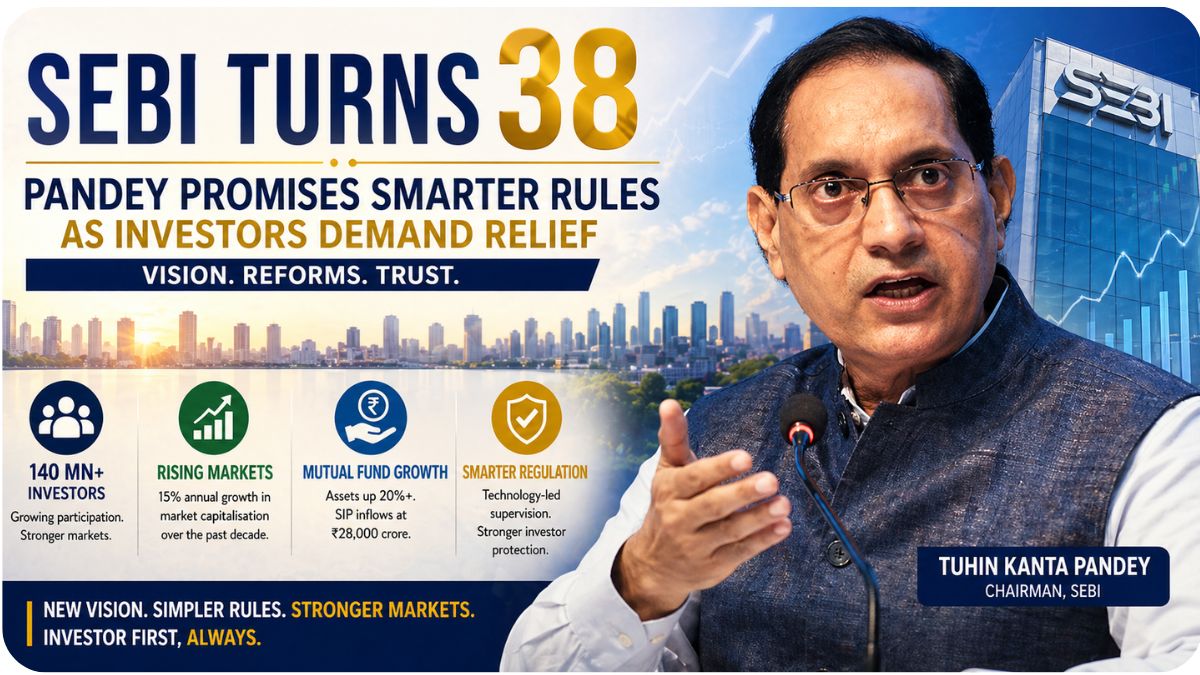
Pandey did not pretend that the journey had been easy. But he pointed to numbers that show why India’s markets remain worth believing in. The country now has over 5,900 listed companies and more than 140 million unique investors.
Market capitalisation has grown at roughly 15 per cent annually over the past decade. Mutual fund assets have expanded by over 20 per cent. Monthly SIP inflows have touched Rs 28,000 crore. From open outcry trading floors to technology-driven platforms, from paper share certificates to demat accounts held by millions of first-generation investors, the transformation has been extraordinary.
And now, Pandey said, the focus shifts. SEBI will rationalise regulations, not pile more on top. It will invest in technology-led supervision so that oversight becomes smarter rather than heavier. It will work to remove ambiguities and improve the ease of doing business.
The regulator, he emphasised, has already undertaken wide-ranging reforms in the past year to simplify rules and strengthen investor protection simultaneously. His message to market participants was equally direct. Go beyond compliance. Uphold fairness, integrity and innovation. And to investors, he said something simple but important: stay informed and stay responsible.
For people who have spent months feeling like they are being squeezed from every direction, that shift in tone, from enforcement to partnership, meant something. The commitment that SEBI will rationalise regulations is not a small promise. It is an acknowledgement that the regulator itself understands the cost of complexity on ordinary people.
Sitharaman Raises the Bar Further
Finance Minister Nirmala Sitharaman was equally pointed in what she asked SEBI to do next.
Her most urgent call was on KYC. For years, investors in India have had to go through fresh verification processes every time they open a new account, sign up for a new financial product or move to a new platform. It is one of those everyday frustrations that rarely makes headlines but quietly exhausts anyone who tries to engage with more than one financial service at a time.
Sitharaman called on SEBI to lead the creation of uniform KYC norms across the entire financial sector, building a framework that is seamless, secure and portable. The proposal has already been discussed at the Financial Stability and Development Council, which means this is not just a speech.
There is institutional machinery behind it. And Sitharaman was clear that SEBI, given its scale of investor participation and robust digital infrastructure, is the right body to drive it.
She pushed on the bond markets next. India’s corporate bond market has long been dominated by top-rated issuers. Fundamentally sound companies with lower credit ratings have struggled to raise capital through debt because the infrastructure to support them simply is not deep enough.
Sitharaman called for stronger credit enhancement mechanisms to change that, along with a parallel push to finally develop a meaningful municipal bonds market, something India has talked about for years without fully delivering.
On the global front, she urged SEBI to engage more actively with international regulators. Cross-border capital flows are growing. New risks, from artificial intelligence being used in trading to sustainable finance disclosures to settlement interoperability across markets, require coordinated global responses.
Her argument was clear: the more the world understands how SEBI works, the more confidence global investors have in Indian markets and the more weight India carries when international financial rules are being written.
ALSO READ |SEBI Algo Trading Norms Go Live, A New Era of Safer Trading Begins for Investors
What This Means for the Investor Sitting at Home

The honest reality is that the regulatory burden of the past year has been painful for many people. The STT hike took money directly out of traders’ pockets. The margin rules demanded more capital for the same positions.
The algo framework added compliance steps that felt designed for institutions, not individuals. The mutual fund changes, while largely positive over the long term, asked everyone to relearn cost structures they thought they understood.
But markets, like most things in life, move in cycles. Periods of tightening are usually followed by periods of consolidation and, eventually, simplification. What Pandey signalled on Saturday is that SEBI may be entering that second phase.
Not a retreat from regulation, but a maturation of it. And at the centre of that maturation is a straightforward commitment: SEBI will rationalise regulations so that they serve investors rather than burden them.
India’s capital markets have earned their place among the world’s most watched. Over 140 million investors have trusted the system with their savings, their retirement plans and their children’s futures. That trust is not a given.
It has to be earned, maintained and protected. SEBI seems to know that. And if Saturday’s words translate into action over the coming months, investors may finally get the one thing they have been quietly asking for: a regulator that is as interested in their confidence as it is in their compliance.
Because when SEBI will rationalise regulations in deed and not just in speech, that is when India’s markets will truly be ready for their next chapter.
ALSO READ |SEBI Eases Certification Requirement, Thousands of Market Professionals to Benefit
Disclaimer:
This article is written for informational and educational purposes only. It is based on publicly available statements made at SEBI’s 38th Foundation Day event and regulatory announcements. Nothing in this article should be construed as financial, legal or investment advice. Readers are advised to consult a SEBI-registered financial adviser before making any investment decisions. Market investments are subject to risk.

Dr. Bidyut Barun Sarmah, with 22+ years of experience in print, electronic, and digital media, holds an MA and PhD in Mass Communication and Journalism. He has worked with AIR, Doordarshan, and the Publication Division under the Ministry of Information and Broadcasting. A published author and researcher, Dr. Sarmah writes extensively in both Assamese and English. He was also awarded a prestigious fellowship by the Ministry of Culture, Government of India, for his study on journalistic literature—an achievement that highlights his depth of scholarship and contribution to media studies. At Nest of News, he leads the editorial team and contributes across diverse topics.
1 thought on “SEBI Will Rationalise Regulations, Says Pandey at 38th Foundation Day, But Exhausted Investors Want to See It Happen Soon”
Comments are closed.