

|
Getting your Trinity Audio player ready...
|
There is a particular kind of helplessness that every options trader in India has felt at least once. The market moves fast and hard in one direction. Your instincts are right, your timing is right, but the strike price you need simply is not there. The contract does not exist. And by the time the exchange catches up, the opportunity has already gone.
That quiet frustration has been part of Indian derivatives trading for years. And now, for the first time, SEBI’s real-time options strike price proposal is directly acknowledging that problem and offering a concrete, structured solution to it.
SEBI Real-Time Options Strike Price Signals a New Era of Trader Protection in India
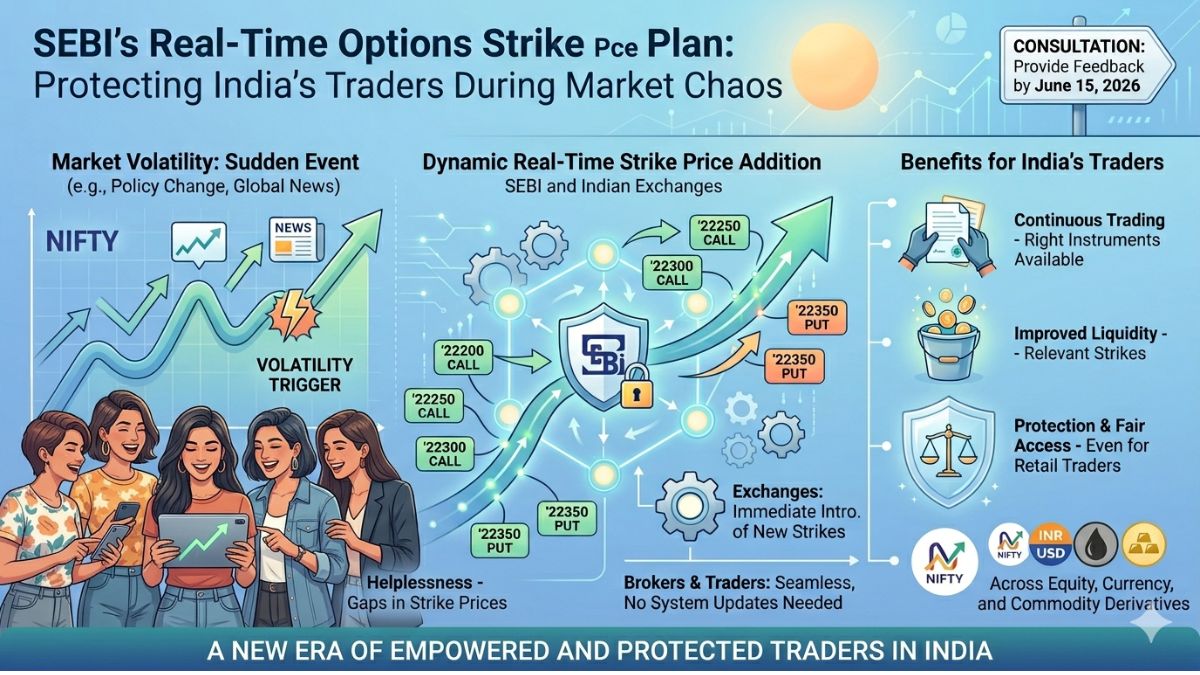
The Securities and Exchange Board of India unveiled this proposal through a formal consultation paper, and the core idea behind it is both simple and overdue.
When markets move sharply during live trading hours, exchanges must introduce new options strike prices in real time, in the direction of that movement, so that traders always have relevant and usable contracts available to them at any point during the session.
A strike price, for those newer to derivatives, is the fixed price at which an options contract can be exercised. When the market price of an underlying asset moves far away from existing strike prices, those contracts lose their usefulness. Traders are left without the right instruments at precisely the moment they need them most.
SEBI has recognised this gap and is moving to close it. The proposal asks exchanges to maintain a minimum number of in-the-money and out-of-the-money contracts at all times and to conduct daily reviews, ensuring sufficient strike coverage around current market levels.
ALSO READ |SEBI Proposes Third-Party Payments in Mutual Funds: A Bold Shift That Could Change How India Invests
What Makes This Proposal Different from Everything That Came Before
India’s derivatives market has grown at a pace that has surprised even its most enthusiastic participants. Weekly expiries, massive retail participation, intraday strategies built around options, all of this has created a trading ecosystem that is fast, deep and sometimes unforgiving.
The existing system of strike price management was built for a different era. Additions happened on scheduled timelines, reviewed periodically rather than dynamically. That worked reasonably well when markets moved in measured steps.
But modern Indian markets do not always move in measured steps. A single announcement from the Reserve Bank of India, an unexpected global event, a sudden shift in institutional sentiment, any of these can move the Nifty or BankNifty by hundreds of points within minutes.
SEBI’s real-time addition of the options strike prices framework is specifically designed for this reality. The moment the underlying asset moves sharply, exchanges will be obligated to respond immediately, introducing new strike prices in the direction of that movement without waiting for the next scheduled review cycle.
That responsiveness is what makes this proposal genuinely different and genuinely valuable.
The Detail That Will Matter Most to Brokers and Trading Firms
Every time a regulatory change touches live market infrastructure, brokers and technology teams brace themselves. System updates, platform reconfigurations and emergency patches during trading hours are among the most stressful situations a brokerage can face.
SEBI has thought about this carefully. The proposed framework is explicitly designed so that the intraday introduction of new strike prices requires no system modifications from brokers or market participants during live trading sessions.
The changes happen entirely at the exchange level. Brokers do not need to update software, reconfigure platforms or alert their technology teams mid-session. The new strike prices simply appear within the existing system framework as if they had always been there.
For a retail trader at home, this means the experience will be seamless. For a brokerage managing tens of thousands of simultaneous client positions, this assurance is worth more than it might initially seem.
This Reform Goes Far Beyond Just Equity Options
One of the most underreported aspects of this proposal is its scope. SEBI has made clear that the real-time options strike price framework will apply not only to equity derivatives but also to currency and commodity derivatives segments.
This is significant. A sharp move in the Indian rupee against the dollar can leave currency options traders just as stranded as an equity trader during a Nifty flash move. Commodity traders watching crude oil spike or gold surge face the same problem.
By extending the framework uniformly across all three segments, SEBI is establishing a consistent standard of continuity and liquidity protection across the entire derivatives landscape, not just the most visible corner of it.
Exchanges will retain the flexibility to determine operational specifics such as strike intervals, the number of contracts to be introduced and the precise thresholds that trigger new additions. This flexibility is sensible and appropriate. A highly active equity index options chain and a thinly traded regional commodity options segment require different calibration, and exchanges are best placed to make those judgments.
At the same time, exchanges will also clean up periodically by removing strike prices that have drifted far from current market levels. This prevents the options chain from becoming cluttered with irrelevant contracts, keeping the market focused, efficient and easier to navigate for everyone.
Why Ordinary Retail Traders Should Care About This More Than Anyone Else
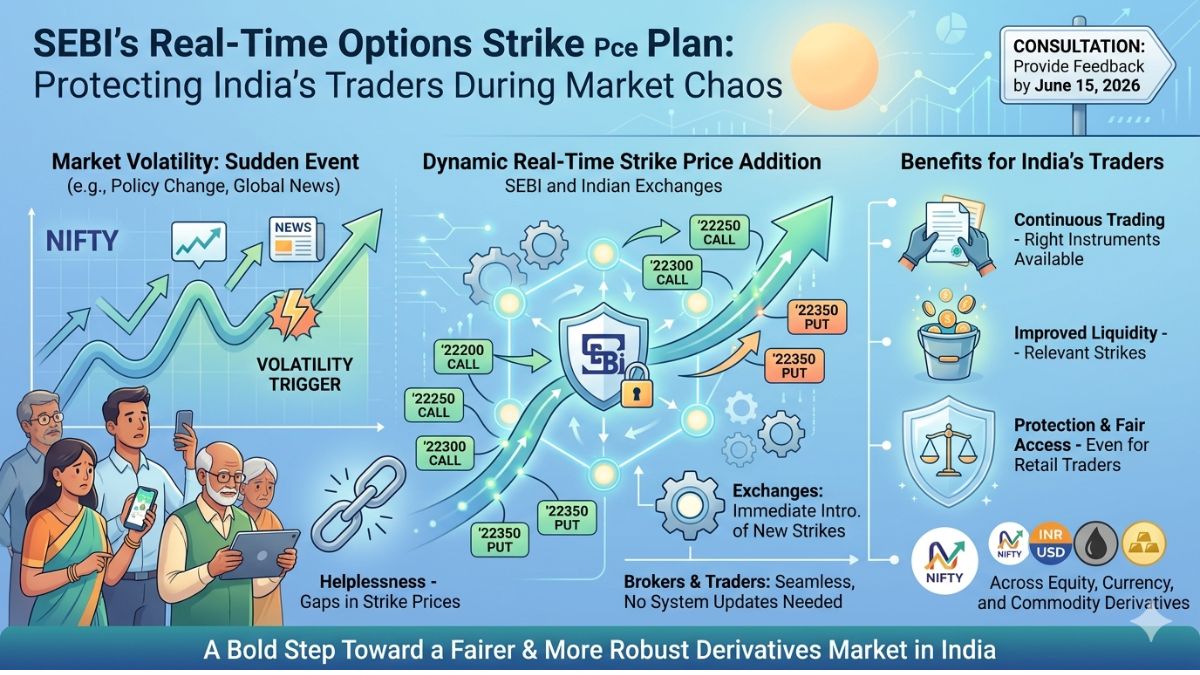
Institutional players have always had tools and relationships that help them navigate gaps in market structure. When strike prices are unavailable, a large institutional desk has alternatives, workarounds and direct access that a retail trader simply does not have.
The retail options trader sitting at home, managing their own capital, working with a discount broker app on a phone, has no such cushion. When the contract they need does not exist, they are simply out of options, literally and figuratively.
SEBI’s proposal is meaningful precisely because it strengthens the infrastructure that retail traders depend on most. It treats the availability of appropriate strike prices not as a convenience but as a basic requirement of a functioning market.
India has seen extraordinary growth in retail derivatives participation over recent years. With that growth comes a responsibility to ensure that the market infrastructure serves those participants fairly. This proposal is a step in that direction and an important one.
The Road Ahead and What Traders Should Watch For
SEBI has invited public comments on the proposal with a deadline of June 15, 2026. This is a genuine opportunity for market participants, whether retail traders, brokers or institutional players, to contribute their practical experience to the shaping of this framework.
After the consultation window closes, SEBI will review the feedback received and move toward finalising the rules. Exchanges will then be given implementation timelines to build and test the required systems before the framework goes live.
The direction is clear, and the intent is strong. Whether the final framework perfectly captures every nuance that traders need will depend in part on the quality of feedback SEBI receives during this consultation period.
For anyone who trades options in India, paying attention to this process and participating in it is worth the effort. The rules being written right now will shape how Indian derivatives markets function for years to come.
ALSO READ |SEBI Shuts IRRA Platform, Stronger Systems Bring Relief: Traders Fear Future Risks
Disclaimer:
This article has been written solely for informational and educational purposes based on publicly available details from SEBI’s consultation paper on options strike price management. Nothing contained in this article should be interpreted as financial advice, investment guidance or trading recommendations of any nature. Readers are strongly encouraged to consult a SEBI-registered financial advisor before making any trading or investment decisions. The proposed framework, its final scope and its implementation date remain subject to change following the public consultation process ending June 15, 2026. For official and updated information, readers should refer directly to sebi.gov.in. The author and publisher bear no responsibility for any financial decisions or trading outcomes based on the content of this article.

Dr. Bidyut Barun Sarmah, with 22+ years of experience in print, electronic, and digital media, holds an MA and PhD in Mass Communication and Journalism. He has worked with AIR, Doordarshan, and the Publication Division under the Ministry of Information and Broadcasting. A published author and researcher, Dr. Sarmah writes extensively in both Assamese and English. He was also awarded a prestigious fellowship by the Ministry of Culture, Government of India, for his study on journalistic literature—an achievement that highlights his depth of scholarship and contribution to media studies. At Nest of News, he leads the editorial team and contributes across diverse topics.
2 thoughts on “SEBI’s Real-Time Options Strike Price Plan Is the Boldest Step Yet Toward Protecting India’s Traders During Market Chaos”
Comments are closed.