
|
Getting your Trinity Audio player ready...
|
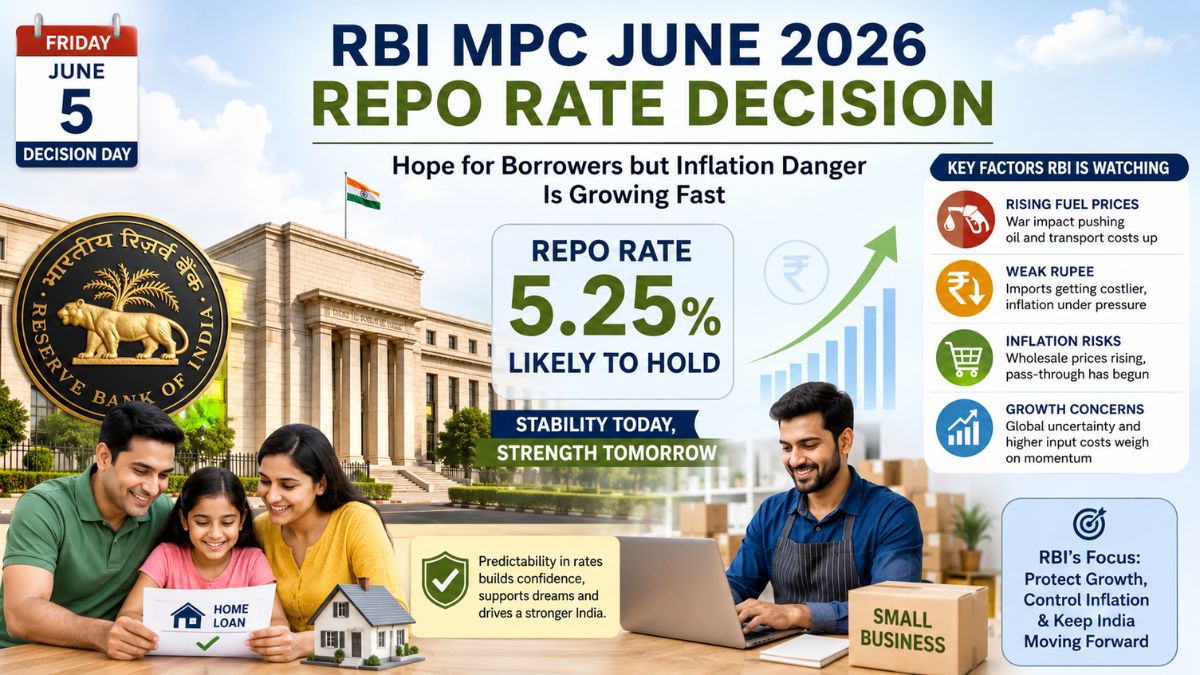
Some announcements change nothing on paper but everything in feeling. Friday, June 5, is one of those days for India. Across the country, families with home loans are quietly hoping, small business owners are doing nervous mental math, and first-time homebuyers are waiting to see whether their EMI dreams stay intact or get a little harder to reach.
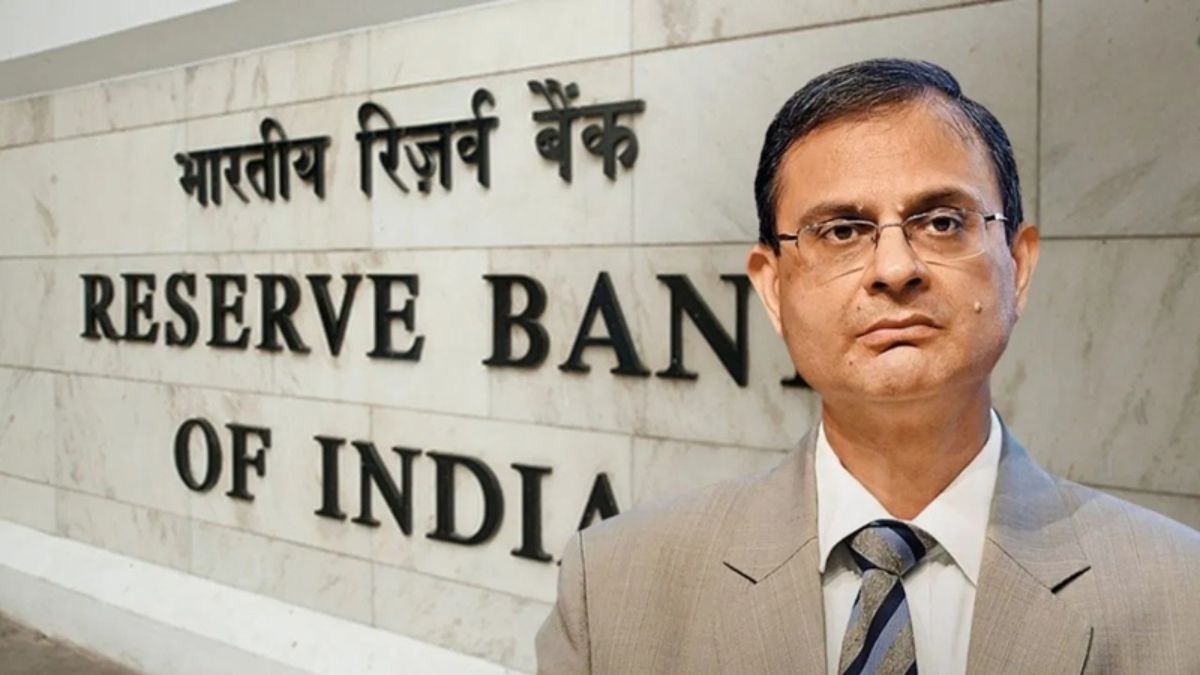
The Reserve Bank of India’s Monetary Policy Committee began its three-day meeting on Wednesday, June 3, chaired by Governor Sanjay Malhotra. The RBI MPC June 2026 repo rate decision will be announced on Friday morning, and while most economists expect the rate to stay unchanged at 5.25 per cent, the world outside India’s borders is making that conversation far more complicated than it sounds.
War, oil prices, a weakening rupee and rising costs at the farm and factory level are all knocking on the door at the same time. The RBI is being asked to hold steady while a storm brews quietly around it.
RBI MPC June 2026 Repo Rate Decision: A Delicate Balance Between Protecting Growth and Fighting Inflation
There is a reason why every monetary policy meeting feels personal to so many Indians. The repo rate, the rate at which the RBI lends money to commercial banks, feeds directly into home loan rates, car loan EMIs, business credit costs and savings return. When it moves, millions of lives feel it, sometimes immediately, sometimes over months.
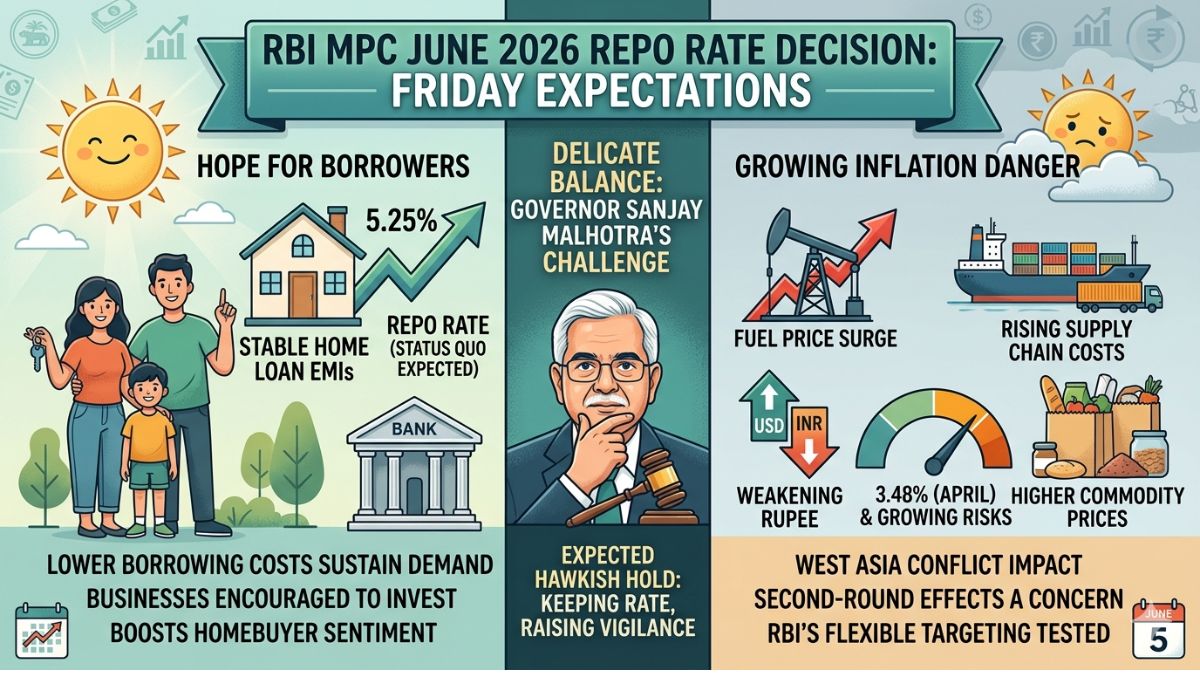
Right now, the repo rate sits at 5.25 per cent after the RBI had already delivered a cumulative 100 basis points of rate cuts during 2025-26. Those cuts brought relief. They made home loans slightly more affordable, encouraged businesses to borrow and invest, and gave the housing market a meaningful lift. That progress is now something the RBI wants to protect.
But protecting it is not easy when the West Asia conflict is sending fuel costs higher by the week.
Petrol and diesel pump prices have gone up. Commercial LPG costs have risen. Wholesale prices are climbing, and manufacturers across India have already signalled that they are ready to pass those higher input costs onto consumers. The retail inflation number for April was a relatively comfortable 3.48 per cent, but that figure may not stay comfortable for very long.
ALSO READ |RBI Kill Switch May Finally Give Indians the Power to Stop Bank Fraud Before It Is Too Late
Why the West Asia Conflict Is Sitting at the Centre of This Friday’s Decision
It would be easy to think of the West Asia conflict as a distant problem. It is not. Every rupee that India spends importing oil, every extra cost that truckers pass onto wholesalers, every price increase at the local kirana store traces part of its journey back to what is happening in that region right now.
Yes Bank’s research team noted that the pass-through from wholesale prices to consumer prices has already begun. Supply chains, which were only just recovering from earlier disruptions, are under pressure again. The rupee has weakened against the dollar, making imports more expensive across the board and adding another layer of cost pressure onto an economy that was otherwise doing reasonably well.
The RBI is caught between two realities. Inflation, while still within the official tolerance band of 2 to 6 per cent, is showing signs of moving upward. Growth, while resilient, faces headwinds from rising input costs and global uncertainty. Raising rates too soon could hurt growth. Waiting too long could allow inflation to take root.
Gaura Sen Gupta, Chief Economist at IDFC First Bank, put it well when she said the RBI’s flexible inflation-targeting framework gives it the room to look through the first round of fuel price increases without immediately reaching for a rate hike. The key phrase is “first round.” If prices keep rising and the increase spreads into wages and broader consumer goods, the second round could force the RBI’s hand.
What India’s Top Economists Are Expecting on Friday
The consensus among economists and analysts is clear: the repo rate will stay at 5.25 per cent on Friday. But the tone of what Governor Malhotra says alongside that decision could shift sentiment in markets and signal what comes next.
Abhishek Bisen of Kotak Mahindra AMC described the likely outcome as a hold with a hawkish lean. In plain terms, that means the RBI keeps the rate unchanged for now but sends a clear message that it is watching inflation closely and is prepared to act if things worsen. Inflation forecasts are expected to go up. Growth projections may come down slightly.
HSBC’s Chief India Economist Pranjul Bhandari described it as a close call, adding that the RBI would likely be cautious about appearing to raise rates purely to defend the rupee. Such a move would blur the lines between monetary policy and currency management, and the RBI has historically preferred to keep those two levers distinct.
For borrowers, this means the immediate picture is stable. No rate hike on Friday most likely means no immediate jump in EMIs. But the language from the RBI will tell a story about where things are headed, and that story deserves careful attention.
ALSO READ |Six Big Money Rules Changing from June 1 That Could Hit Every Indian Hard
What This Means for Home Buyers, Small Businesses and Everyday Families
Real estate is one of the sectors watching Friday’s announcement most closely. The cumulative rate cuts of the past year helped push housing demand meaningfully higher, and the industry is hoping that stability continues.
Kunal Rishi, COO of Krisumi Corporation, said clearly that lower borrowing costs are critical to sustaining homebuyer demand and keeping housing affordable. Tanuj Shori, CEO of Square Yards, pointed out that for prospective buyers, predictability of interest rates is not a nice-to-have feature; it is a central factor in the decision to buy.
For small businesses, freelancers and gig workers, the stakes are equally real. Mythri Kumar, co-founder and CEO of TimbuckDo, said a stable rate environment helps build business confidence, encourages investment and creates more room for the growing population of young Indians building their careers outside traditional employment.
Gaurav Maheshwari, CFO of Alankit Limited, noted that while domestic fundamentals remain healthy, cost-driven shocks from fuel and global commodities are pushing retail inflation projections closer to the 5 per cent mark. A neutral stance from the RBI, he said, protects predictable borrowing costs in the short term and supports corporate credit momentum.
India Is Listening, and Friday Matters More Than the Number Itself
When Governor Sanjay Malhotra speaks on Friday morning, the repo rate announcement will come first. But everything that follows, the inflation forecast revision, the growth outlook, the tone of the statement and the stance of the committee, will tell a more complete story about where India’s economy is headed.
A hold at 5.25 per cent is widely expected. What is less certain is whether the RBI sounds cautiously optimistic or genuinely concerned about the months ahead. That difference in tone can move markets, shift sentiment among homebuyers, and give businesses either confidence or pause.
For the millions of Indians whose financial lives are quietly shaped by decisions made in RBI boardrooms, Friday is not just a policy date on a calendar. It is a moment that answers a question many of them are carrying into the week: is the stability we have been enjoying safe, or is something harder quietly on its way? India will find out on Friday morning.
Disclaimer:
This article is based on information available at the time of publication. All interest rate decisions, forecasts and policy stances remain subject to the Reserve Bank of India’s official announcements. The views expressed by industry experts and economists quoted in this article are their own and do not represent the editorial stance of this publication. This article is intended for general informational purposes only and should not be construed as financial, investment or legal advice. Readers are encouraged to consult a certified financial adviser before making any borrowing, investment or financial planning decisions.

Dr. Bidyut Barun Sarmah, with 22+ years of experience in print, electronic, and digital media, holds an MA and PhD in Mass Communication and Journalism. He has worked with AIR, Doordarshan, and the Publication Division under the Ministry of Information and Broadcasting. A published author and researcher, Dr. Sarmah writes extensively in both Assamese and English. He was also awarded a prestigious fellowship by the Ministry of Culture, Government of India, for his study on journalistic literature—an achievement that highlights his depth of scholarship and contribution to media studies. At Nest of News, he leads the editorial team and contributes across diverse topics.